

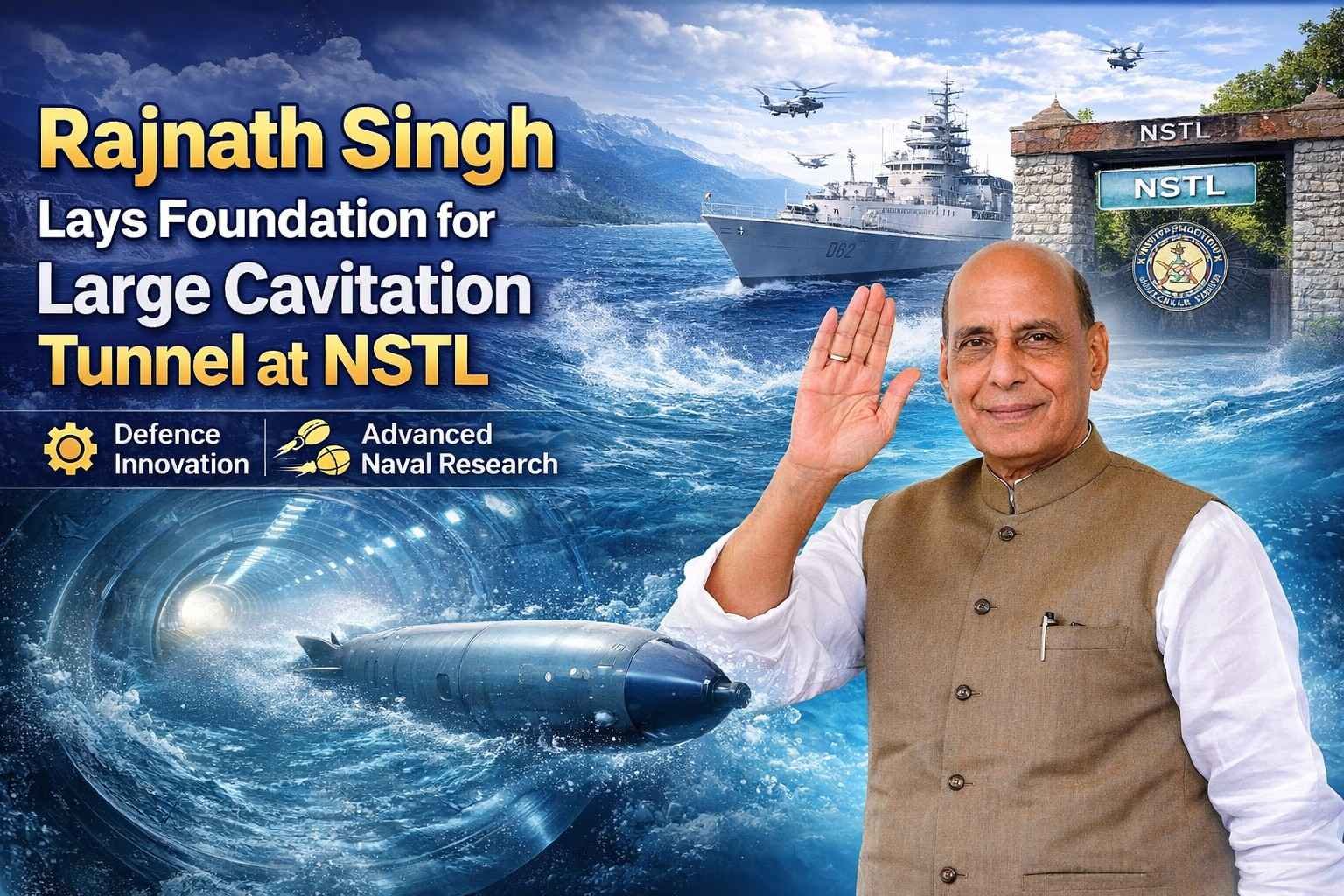
In a significant step towards strengthening India’s naval capabilities, Rajnath Singh laid the foundation stone for a Large Cavitation Tunnel (LCT) at the Naval Science and Technological Laboratory (NSTL). This advanced facility will support cutting-edge research in underwater technologies, especially for submarines, torpedoes, and naval platforms.
The project is crucial for enhancing India’s defence self-reliance under the Atmanirbhar Bharat initiative and will significantly boost indigenous naval research and development.
Significance of the Large Cavitation Tunnel:
The Large Cavitation Tunnel is a highly specialized facility used to study hydrodynamics and cavitation effects in water. Cavitation—formation of vapor bubbles in liquids—can impact the performance, noise, and durability of marine systems.
Why This Project Matters:
- Strengthens the Indian Navy’s underwater warfare capabilities
- Supports development of advanced submarines and torpedoes
- Reduces dependence on foreign testing facilities
- Promotes indigenous defence manufacturing
- Enhances stealth technology (low noise propulsion systems)
This initiative also indirectly supports the Indian shipping industry and maritime research ecosystem by advancing knowledge in marine engineering.
Conclusion:
The foundation of the Large Cavitation Tunnel marks a major leap in India’s defence and maritime capabilities. With the growing geopolitical importance of oceans, such infrastructure ensures India remains prepared, technologically advanced, and self-reliant.
This project not only strengthens national security but also contributes to innovation in the broader maritime ecosystem, aligning with India’s vision of becoming a global maritime power.