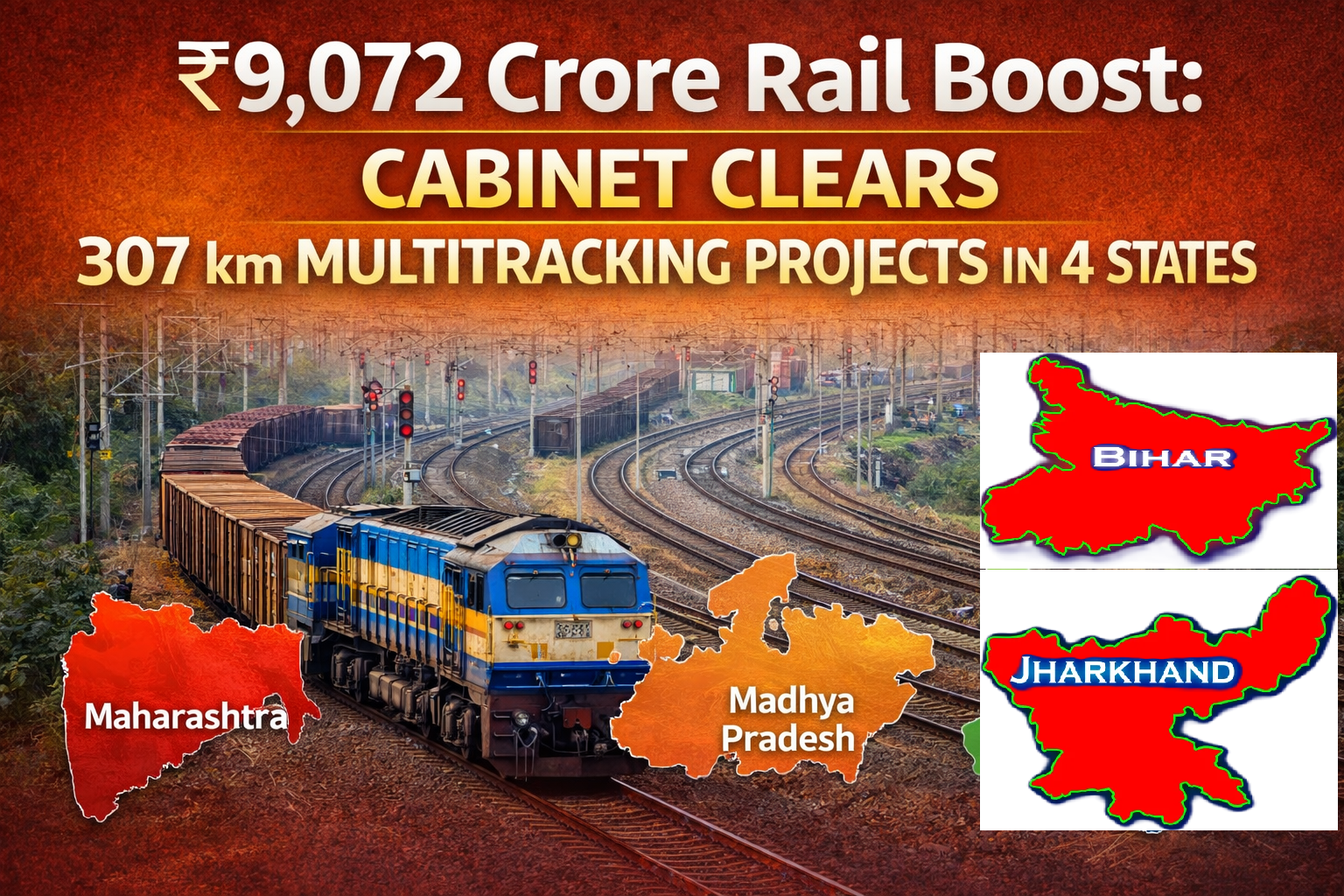
In a significant push to strengthen India’s railway infrastructure, the Cabinet Committee on Economic Affairs (CCEA) has approved three major multitracking projects worth ₹9 072 Crore Rail Boost.
The projects aim to ease congestion, expand freight capacity, and improve connectivity across key mineral and industrial corridors in Maharashtra, Madhya Pradesh, Bihar, and Jharkhand.
The approved works include the Gondia–Jabalpur doubling project, and the addition of third and fourth lines between Punarakh–Kiul and Gamharia–Chandil. Together, these upgrades will add nearly 307 km to the Indian Railways network and are scheduled for completion by 2030–31.
Planned under the PM-Gati Shakti National Master Plan, the projects are designed to decongest some of the busiest freight routes in the country while enhancing the reliability of passenger services.
Once operational, the expanded network is expected to improve connectivity for around 5,407 villages, benefiting an estimated population of nearly 98 lakh people.
The corridors play a crucial role in transporting bulk commodities such as coal, steel, cement, fertilizers, and foodgrains. With additional capacity, Indian Railways is projected to handle nearly 52 million tonnes of extra freight traffic annually. This is expected to reduce logistics bottlenecks and lower transportation costs for industries.
The modal shift from road to rail — a more energy-efficient alternative — could also yield environmental benefits. Officials estimate savings of nearly 6 crore litres of oil imports and a reduction of about 30 crore kilograms of carbon emissions, equivalent to planting one crore trees.
Beyond freight and industry, the upgraded lines are likely to improve access to regional hubs and tourist destinations, reinforcing the government’s broader strategy of linking infrastructure expansion with economic growth and environmental sustainability.