



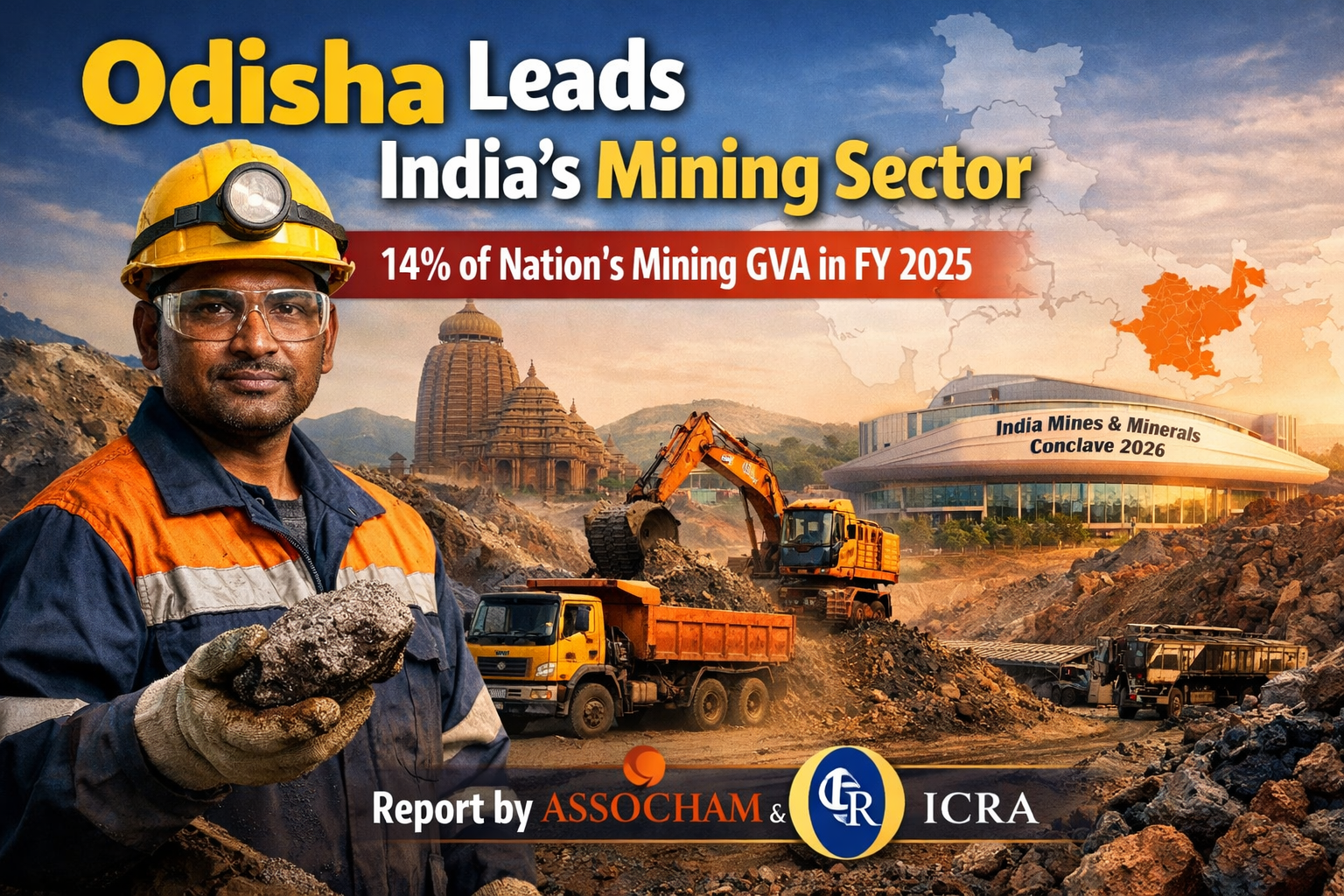
Odisha has emerged as the largest contributor to India’s mining sector, accounting for nearly 14% of the country’s mining Gross Value Added (GVA) in FY2025. This was revealed in a report released during the India Mines and Minerals Conclave 2026 held in Bhubaneswar.

The report, prepared jointly by industry body ASSOCHAM and credit rating agency ICRA using data from the Ministry of Statistics and Programme Implementation (MoSPI), highlights the growing dominance of mineral-rich states in India’s economic landscape.
Top Mining States in India
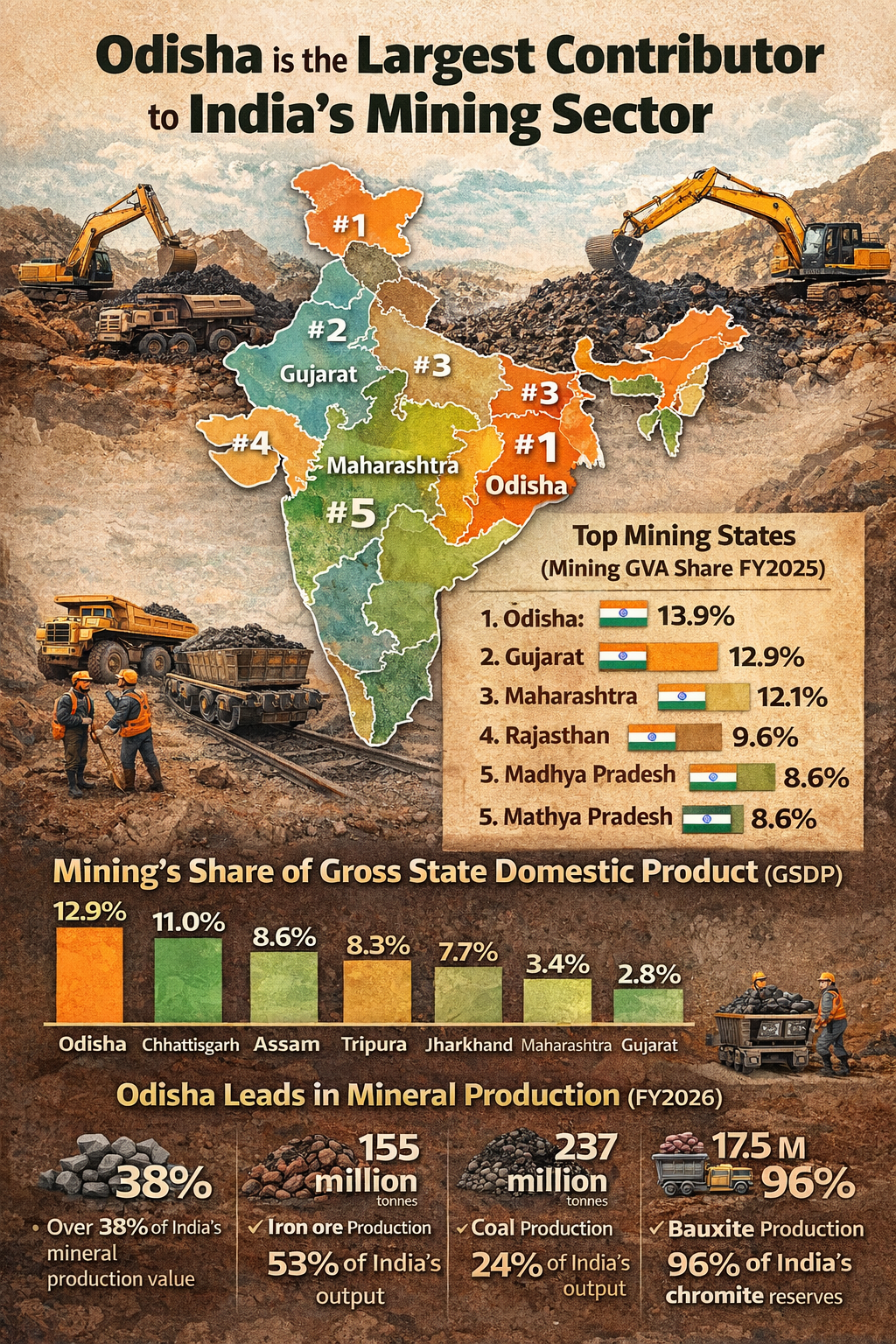
- After Odisha, Gujarat ranked second with a 12.9% share in mining GVA, followed by Maharashtra (12.1%), Rajasthan (9.6%), and Madhya Pradesh (8.6%).
- Together, these five states contribute more than 57% of India’s total mining GVA, indicating a high concentration of mining activity in a few regions.
Mining’s Role in State Economies
- The report points out that a large mining sector does not always translate into a higher contribution to a state’s overall economy.
- For instance, industrially diversified states like Maharashtra and Gujarat have relatively lower mining contributions to their Gross State Domestic Product (GSDP), at 3.4% and 2.8% respectively.
- In contrast, states with rich mineral reserves show a much higher dependence on mining. Odisha leads in this aspect as well, with mining contributing 12.9% to its GSDP.
- Chhattisgarh follows at 11%, while Assam (8.6%), Tripura (8.3%), and Jharkhand (7.7%) also show significant reliance on the sector.
Growth Trends Over the Years
- Over the past decade (FY2015–FY2025), the mining sector in India has witnessed moderate growth overall.
- However, some states have performed exceptionally well. Madhya Pradesh recorded the highest compound annual growth rate (CAGR) at 12.5%, followed by Gujarat (11.9%), Telangana (11.4%), and Odisha (10.8%).
- These states benefited from policy reforms, faster project approvals, improved ease of doing business, and greater private sector participation.
- On the other hand, Jharkhand, despite being rich in minerals, recorded a relatively low growth rate of 4.5%, indicating structural challenges.
Mineral Auctions and Reforms
- The pace of mineral block auctions has become an important indicator of how effectively states are utilizing their resources.
- Madhya Pradesh and Odisha led the country by auctioning 156 and 97 mineral blocks respectively. They were followed by Chhattisgarh, Karnataka, and Maharashtra.
- Different states have focused on different minerals. Odisha has primarily concentrated on iron ore and manganese, while Rajasthan and Andhra Pradesh have focused on limestone and other industrial minerals.
- Maharashtra and Chhattisgarh maintain a more diversified mineral portfolio, including coal, iron ore, and bauxite.
Eastern India: The Mining Hub
- Eastern India continues to dominate the country’s mining landscape. States like Odisha, Jharkhand, Chhattisgarh, and West Bengal form the core of this mineral-rich belt.
- Meanwhile, northeastern states such as Assam and Arunachal Pradesh are gradually emerging, though their output remains limited due to environmental and infrastructure challenges.
Dominance in Mineral Production
- Odisha’s dominance is even more evident in mineral production. The state accounted for over 38% of India’s mineral production value in FY2026 (excluding hydrocarbons and atomic minerals). Rajasthan contributed 23%, followed by Chhattisgarh (14%) and Jharkhand (around 4%).
- In iron ore production, Odisha alone produced about 155 million tonnes in FY2025, accounting for more than 53% of the national output. Jharkhand and Chhattisgarh also remain key contributors.
- In coal production, Odisha produced 237 million tonnes in FY2024, contributing nearly 24% of India’s total output.
- Jharkhand and Chhattisgarh follow closely, while Assam contributes modestly from its reserves.
- Odisha also leads in bauxite production, with 17.5 million tonnes in FY2024, accounting for nearly 73% of India’s total output. Additionally, the state dominates chromite production, holding 96% of the country’s reserves and contributing 100% of production, mainly from the Sukinda Valley in Jajpur district.
Conclusion
The report clearly establishes Odisha as the backbone of India’s mining economy. Its strong resource base, consistent policy support, and efficient utilization of mineral assets have positioned it as a leader in the sector. As India continues to focus on industrial growth and infrastructure development, states like Odisha will play a crucial role in driving the country’s resource-based economic expansion.