

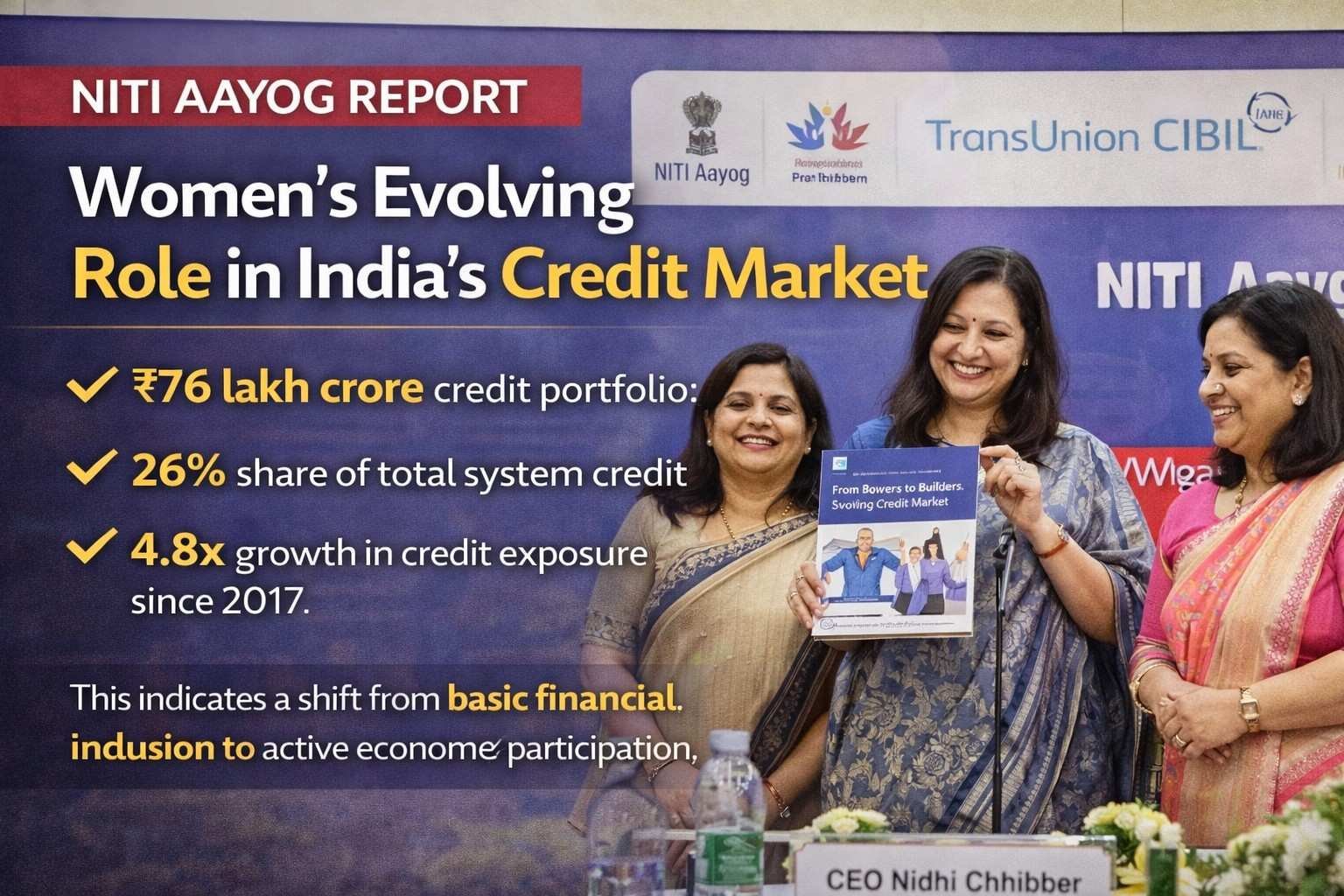
The NITI Aayog has released the second edition of its report titled “From Borrowers to Builders: Women and India’s Evolving Credit Market”.
The report was launched by CEO Nidhi Chhibber in collaboration with:
- Women Entrepreneurship Platform
- TransUnion CIBIL
- MicroSave Consulting
Key Highlights of the Report
- Women now hold a ₹76 lakh crore credit portfolio
- This accounts for 26% of total system credit
- Credit exposure of women has grown 4.8 times since 2017
This indicates a shift from basic financial inclusion to active economic participation.
Growth in Women’s Credit Participation
- Credit-active women borrowers grew at a CAGR of 9% (2017–2025)
- Credit penetration increased from 19% to 36%
- Total credit rose from ₹16 lakh crore (2017) to ₹76 lakh crore (2025)
With nearly 45 crore credit-eligible women, the scope for expansion remains significant.
Shift from Borrowers to Builders
The report highlights a major transformation:
- Women are moving beyond entry-level loans
- Increasing participation in:
- Retail loans
- Business and commercial credit
Notably:
- Credit to women entrepreneurs grew at 31% CAGR (2022–2025)
- This is significantly higher than 17% growth in overall commercial credit
Role of Microfinance and Credit Transition
- Around 19% of MFI borrowers have transitioned to:
- Individual retail loans
- Commercial loans
This shows a shift from informal to formal financial systems.
Geographical Expansion
- Growth is no longer limited to southern and western states
- Northern states like:
- Bihar
- Uttar Pradesh
are witnessing increased participation of women borrowers
Popular Loan Segments
Most accessed credit products:
- Personal loans
- Gold loans
Emerging trend:
- Housing loans are increasing, indicating:
- Rising asset ownership among women
- Improved financial independence
Impact of Digital Public Infrastructure (DPI)
The report highlights the role of:
- Digital identity
- Digital payments
- Data-driven credit underwriting
These innovations have:
- Reduced entry barriers
- Enabled smooth transition to formal credit systems
Insights from Leadership
According to Nidhi Chhibber:
Women are increasingly moving beyond access to credit and are now actively shaping economic participation through deeper engagement in financial systems.
Anna Roy, Mission Director of WEP, emphasised that:
- Growth in women’s credit participation reflects a structural shift in the economy
- Sustaining this momentum requires a strong support ecosystem
Data & Research Base
- Based on credit bureau data of 16 crore women
- Includes primary research on 161 rural nano-entrepreneurs
- Incorporates microfinance data for the first time
Conclusion
The report underscores a significant transformation in India’s credit landscape, where women are transitioning from borrowers to builders. With rising participation, improved access, and digital support systems, women are becoming key drivers of inclusive and sustainable economic growth.