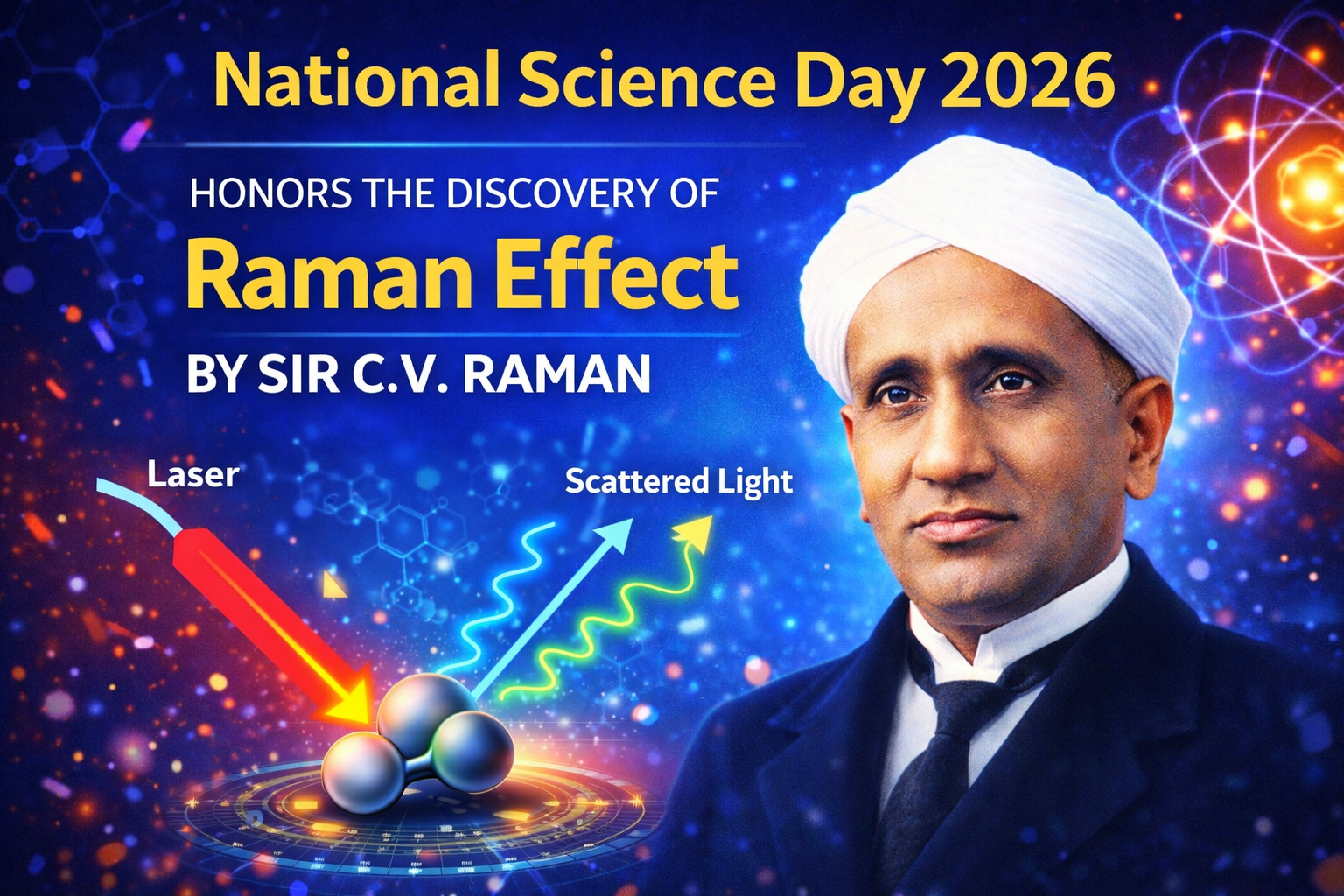
National Science Day is celebrated every year on 28th February to commemorate the discovery of the ‘Raman Effect’ made by the eminent physicist Sir C.V. Raman while working in the laboratory of the Indian Association for the Cultivation of Science, Kolkata.
For this discovery, he was awarded the Nobel Prize in Physics in 1930,making him the first Asian to receive a Nobel Prize in science.
He was also honored with the Bharat Ratna in 1954, India’s highest civilian award.
The theme for 2026 is “Women in Science: Catalysing Viksit Bharat,” highlighting the contributions of women scientists and innovators in advancing India’s scientific progress.
The day is marked by various educational programs, exhibitions, and seminars across the country to promote scientific awareness and encourage students to pursue careers in science and technology.
On National Science Day, theme-based science communication activities are carried out all over the country.
The first celebration took place on February 28, 1987, marking the beginning of a tradition that continues to inspire generations.
Objectives:
The basic objective of the observation of National Science Day is to spread the message of the importance of science and its application among the people.
It is celebrated as one of the main science festivals in India every year with the following objectives:
Widely spread a message about the significance of scientific applications in the daily lives of people.
Display all the activities, efforts, and achievements in the field of science for the welfare of human beings
Discuss all the issues and implement new technologies for the development of science
Encourage the people as well as popularize science and technology.
Who was CV Raman?
CV Raman was born on 7th November 1888, in Tiruchirappalli, Tamil Nadu. He earned his M.A. in Physics from Presidency College, Madras and contributed significantly to atomic physics and optics.
He founded the Raman Research Institute (1948), Indian Journal of Physics (1926), and Indian Academy of Sciences (1934).
His research spanned optics, light scattering, X-rays, acoustics, and sea colors, leading to the discovery of the Raman Effect.
What is Raman Effect:
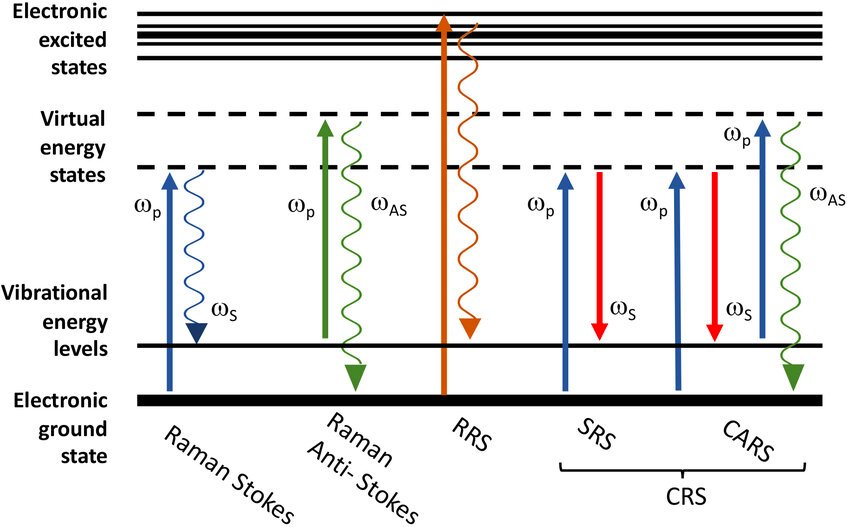
Raman Effect is the change in wavelength (or color) of light when it passes through a transparent substance and gets scattered.
What happens?
When light falls on a molecule, most of it scatters without change (Rayleigh scattering).
A very small portion scatters with a different wavelength.
This change occurs because light transfers some energy to the molecule (or gains energy from it).
Why is it important?
It proves that light interacts with molecular vibrations.
It helps identify chemical substances.
It is the basis of Raman Spectroscopy, used in chemistry, physics, medicine, and forensic science.
It refers to the phenomenon where incoming excitation light interacts with a sample, undergoes a change in wavelength, and generates scattered light due to interactions with molecular vibrations.
This phenomenon is known as Raman scattering.
Its applications expanded after the advent of lasers in the 1960s, aiding chemical analysis by identifying substances without breaking them.
It also helps forensic science detect drugs in sealed evidence bags and enables safe nuclear waste analysis using fiber-optic probes.