

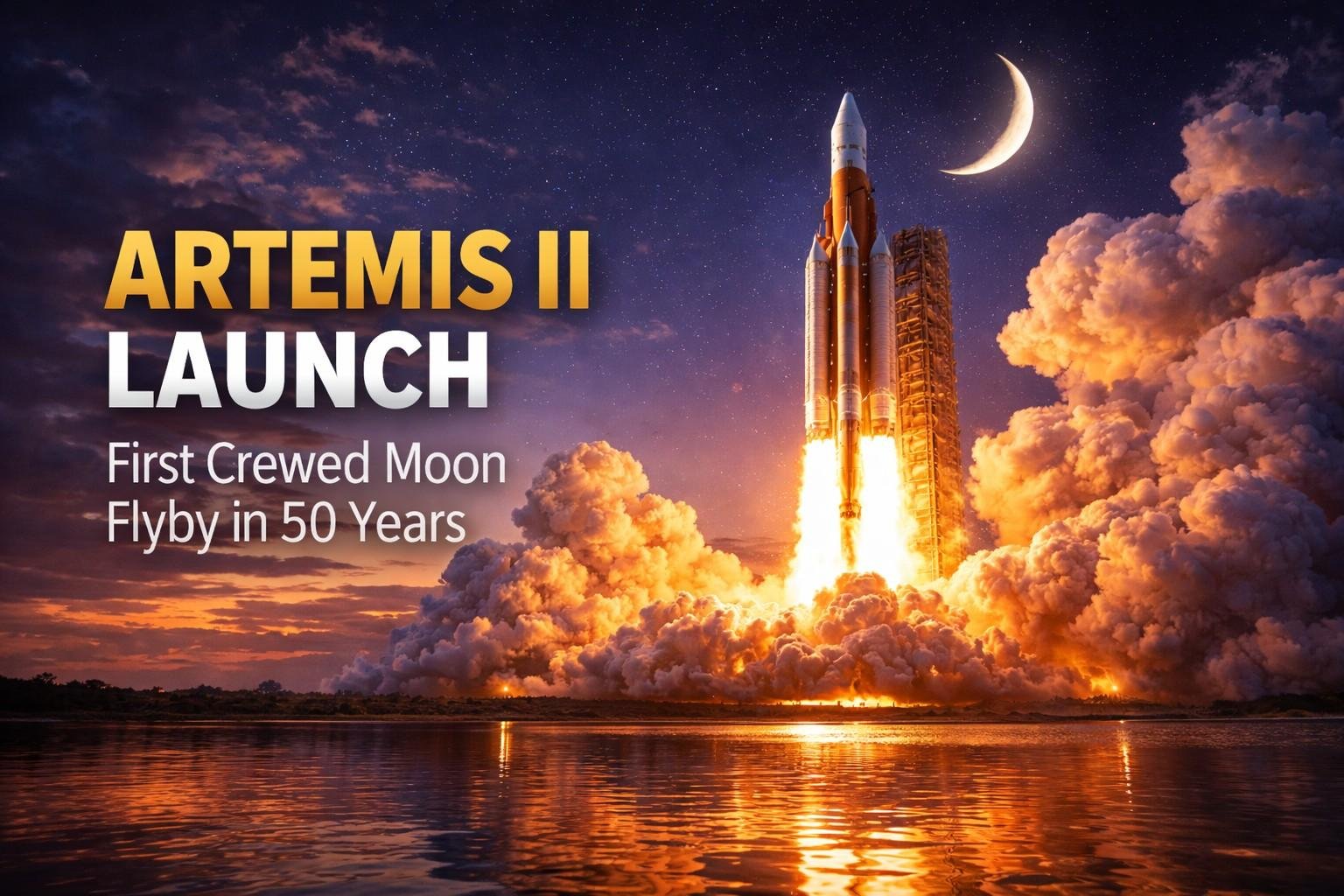
The NASA Artemis II launch made history on April 1, 2026, sending four astronauts on the first crewed Moon flyby since Apollo 17 in 1972.
The Space Launch System (SLS) rocket lifted off from Launch Complex 39B at Kennedy Space Center, Florida, carrying the Orion spacecraft, named Integrity, on a 10-day, 685,000-mile round trip around the Moon.
This is not just another space mission. It is the most significant human spaceflight event in more than half a century, marking America’s return to deep space and setting the foundation for a lunar landing in 2028 and eventual crewed missions to Mars.
Who is on the Artemis II crew?
- Reid Wiseman (Oldest on the Moon crew) – Commander (NASA)
- Victor Glover -Pilot (NASA) -The first person of color to travel to the lunar vicinity.
- Christina Koch– Mission Specialist (NASA) – She is the first woman.
- Jeremy Hansen– Mission Specialist (Canadian Space Agency) – first non-American on a lunar mission.
Together, they shatter the record for the most humans ever in deep space simultaneously, a record previously set at three during Apollo 8 in 1968.
NASA Artemis II launch: what happened on launch day
- The countdown clock started on March 30, and despite a last-minute Flight Termination System issue briefly placing the mission in “No-Go” status just over an hour before liftoff, engineers resolved it using legacy Space Shuttle-era equipment.
- The rocket cleared the tower at T+7 seconds, the solid rocket boosters separated two minutes after liftoff at 29 miles altitude, and within 10 minutes Artemis II was in orbit — travelling at 17,500 miles per hour.
- Shortly after reaching orbit, the Orion spacecraft deployed all four solar array wings, giving it a 63-foot wingspan to draw power from the Sun.
- The crew then performed a proximity operations demonstration — manually maneuvering Orion relative to the spent rocket stage to practice techniques needed for future lunar docking.
Why the NASA Artemis II launch matters: the science
Artemis II is not a sightseeing trip. It carries a full science manifest designed to protect future astronauts on longer lunar surface missions and eventual Mars flights.
- AVATAR (A Virtual Astronaut Tissue Analog Response): Organ-on-a-chip devices that mimic individual astronaut organs, measuring effects of deep-space radiation and microgravity on human health — the first time AVATAR has flown beyond the Van Allen Belt.
- ARCHeR: A watch-like device monitoring crew wellbeing, activity patterns, and sleep quality in deep space.
- Blood and saliva sampling: Researchers will measure changes to the immune system caused by deep-space conditions.
- Lunar far-side photography: Crew-captured images of impact craters and ancient lava flows will help geologists understand the Moon’s formation history — regions no human eye has seen this closely.
- CubeSats: Five shoebox-size satellites from Germany, South Korea, Saudi Arabia, and Argentina deployed five hours post-launch to study radiation environments, space weather, and hardware durability in high-Earth orbit.
What Artemis II means for the Moon and Mars:
- Artemis II is explicitly a test flight. Every system aboard ,life support, Orion’s heat shield, deep-space communications, crew health monitoring, and manual maneuvering, is being validated before human lives depend on them for a lunar surface landing.
- NASA aims for Artemis III to land astronauts on the Moon’s South Pole region in 2028, and Artemis II data will shape every decision made for that mission and beyond.
- We are one mission into a long campaign, NASA Associate Administrator Amit Kshatriya said after launch, and the work ahead of us is greater than the work behind us.
Don’t Miss Daily GK Updates!
Get the latest current affairs directly in your inbox
No spam. Only important updates.