



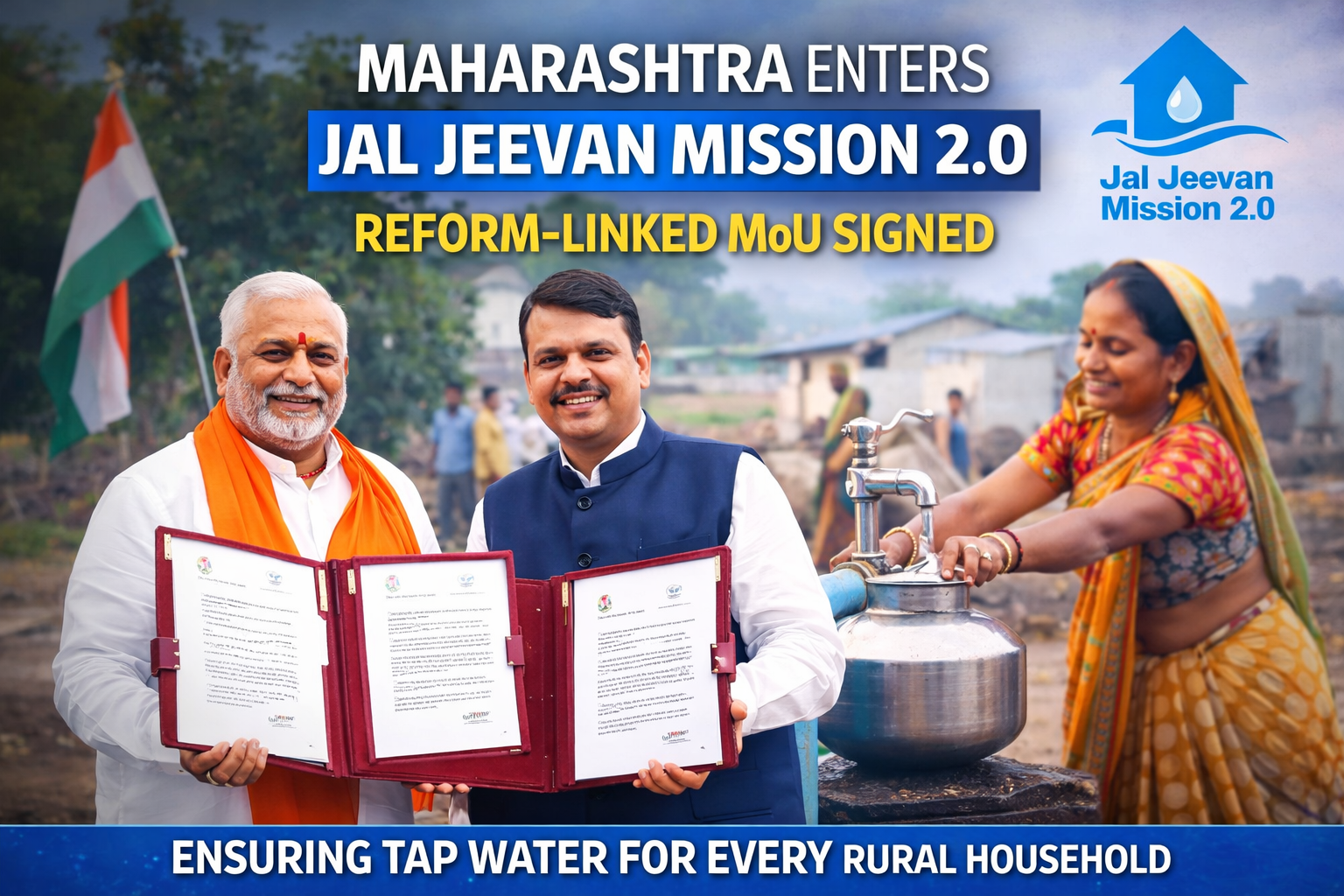
In a major step toward improving rural drinking water infrastructure, the Government of India has signed a reform-linked Memorandum of Understanding (MoU) with the state of Maharashtra under the Jal Jeevan Mission (JJM) 2.0.
The agreement marks Maharashtra’s formal entry into the revamped, reform-driven framework of JJM 2.0, which was recently approved by the Union Cabinet.
High-Level Participation in MoU Signing
The MoU was signed in the presence of Union Jal Shakti Minister C. R. Paatil and Maharashtra Chief Minister Devendra Fadnavis, along with other senior officials from both the Centre and the state.
The agreement was formally exchanged between officials of the Department of Drinking Water and Sanitation (DDWS) and the Maharashtra government.
Focus on Service Delivery and Accountability
JJM 2.0 aims to move beyond infrastructure creation to ensure:
-
Regular and reliable water supply
-
Improved service delivery
-
Greater accountability
-
Long-term sustainability
According to the government, nearly 80% of rural households in India now have access to tap water, marking a significant achievement under the mission.
Transformational Impact on Rural Life
Highlighting the impact of the scheme, Minister C. R. Paatil noted that:
-
Around 9 crore women have been freed from the daily burden of fetching water (as per SBI Research)
-
Universal access to safe drinking water can save 5.5 crore hours daily
-
It could help prevent nearly 4 lakh deaths annually from water-borne diseases (as per WHO estimates)
These outcomes underline the mission’s role in improving health, dignity, and quality of life, especially in rural areas.
Key Reforms Under the MoU
The reform-linked MoU introduces several new mechanisms to strengthen implementation:
1. Jal Seva Aankalan
-
Community feedback system at the Gram Panchayat level
-
Tracks quality, reliability, and regularity of water supply
-
Data visible through the Meri Panchayat App
2. Jal Utsav Campaign
A three-tier awareness initiative:
-
National: Jal Mahotsav
-
State: Rajya Jal Utsav / Nadi Utsav
-
Local: Lok Jal Utsav
This promotes water conservation and community participation.
Strengthening Community Ownership
A major reform under the MoU is the “Jal Arpan” process, under which completed water supply schemes will be handed over to:
-
Gram Panchayats
-
Village Water & Sanitation Committees (VWSCs)
-
Local communities
This ensures local ownership and long-term sustainability of water infrastructure.
Digital and Data-Driven Governance
The agreement also mandates the use of a Decision Support System (DSS) developed by DDWS, which will:
-
Enable data-driven planning
-
Support water source sustainability
-
Integrate with national platforms like Sujalam Bharat
This marks a shift toward technology-driven water governance.
Road Ahead: Towards Water Security
The extension of Jal Jeevan Mission till December 2028 reflects the government’s commitment to:
-
Ensuring safe and adequate drinking water for every rural household
-
Promoting community participation (Jan Bhagidari)
-
Building a sustainable and accountable water supply system
The MoU with Maharashtra is expected to serve as a model for other states, contributing to the vision of Viksit Bharat @2047 and long-term water security in India.