

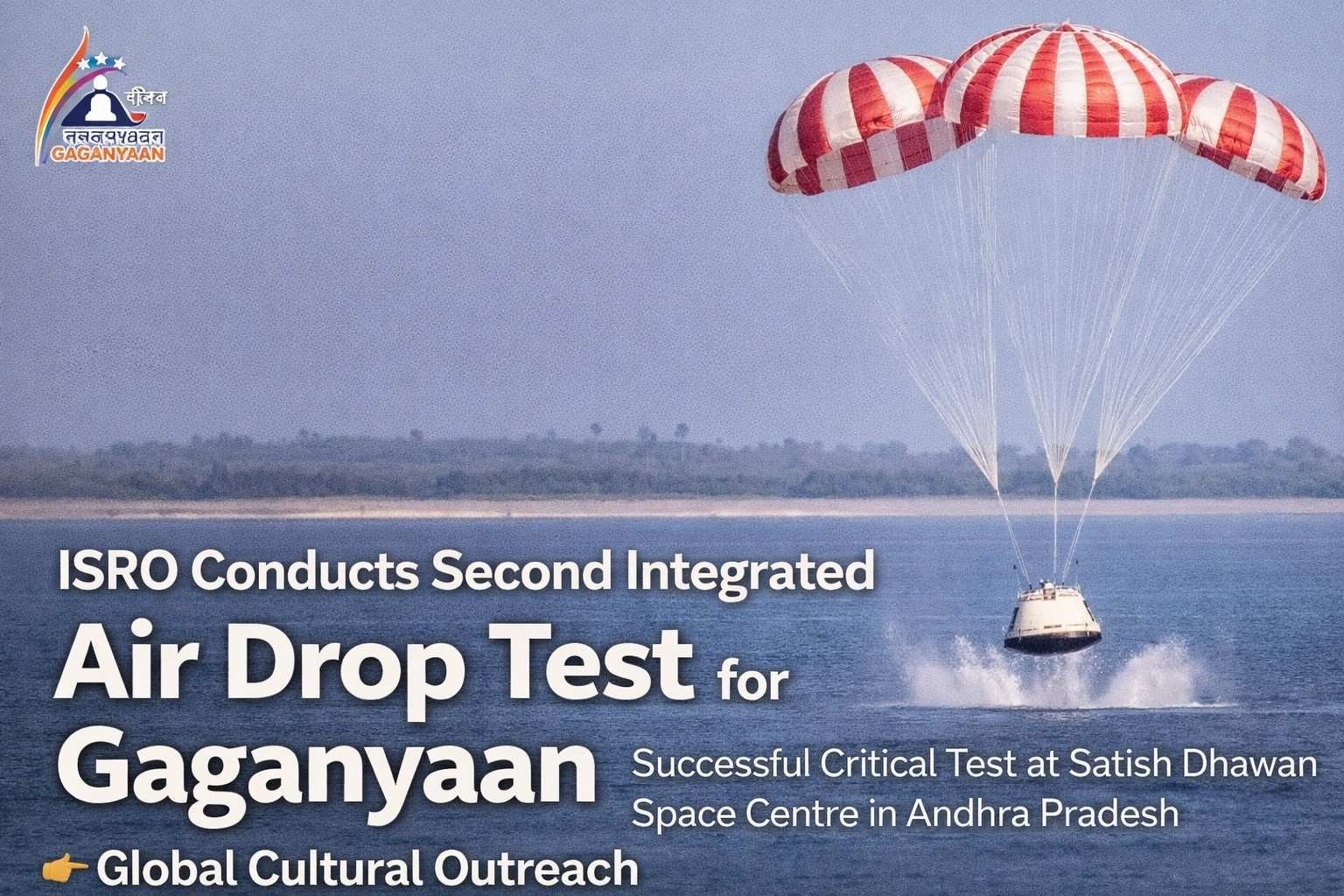
The Indian Space Research Organisation has successfully carried out the Second Integrated Air Drop Test (IADT-02) for its ambitious human spaceflight programme, Gaganyaan.
The test was conducted at the Satish Dhawan Space Centre in Andhra Pradesh.
Purpose of the Air Drop Test
The Integrated Air Drop Test is a critical step to ensure the safe recovery of the crew module, which carries astronauts during the mission.
It helps validate:
- Parachute deployment systems
- Capsule stability during descent
- Safe splashdown in water
What Happens in an Air Drop Test?
Air drop tests simulate the final phase of a spacecraft’s return to Earth:
- The crew module is dropped from a helicopter or aircraft
- Systems are tested under different emergency scenarios, such as:
- Mission abort situations
- Failure of one or more parachutes
- Proper orientation during landing
Details of the IADT-02 Test
- Conducted successfully at Sriharikota
- Follows the first test held on August 24, 2025
- Focuses on ensuring crew safety and recovery mechanisms
Recap of First Air Drop Test (IADT-01)
- A 4.8-tonne dummy crew module was used
- Dropped from a height of 3 km
- A parachute system with 10 parachutes was deployed
- Successfully slowed the capsule for safe splashdown
Significance of the Test
- Ensures astronaut safety during re-entry and landing
- Strengthens India’s readiness for human space missions
- Demonstrates ISRO’s progress toward launching Gaganyaan (expected next year)
Conclusion
The successful completion of IADT-02 marks another milestone for ISRO in its journey toward human spaceflight capability. With each test, India moves closer to joining the elite group of nations capable of independently sending humans to space.