

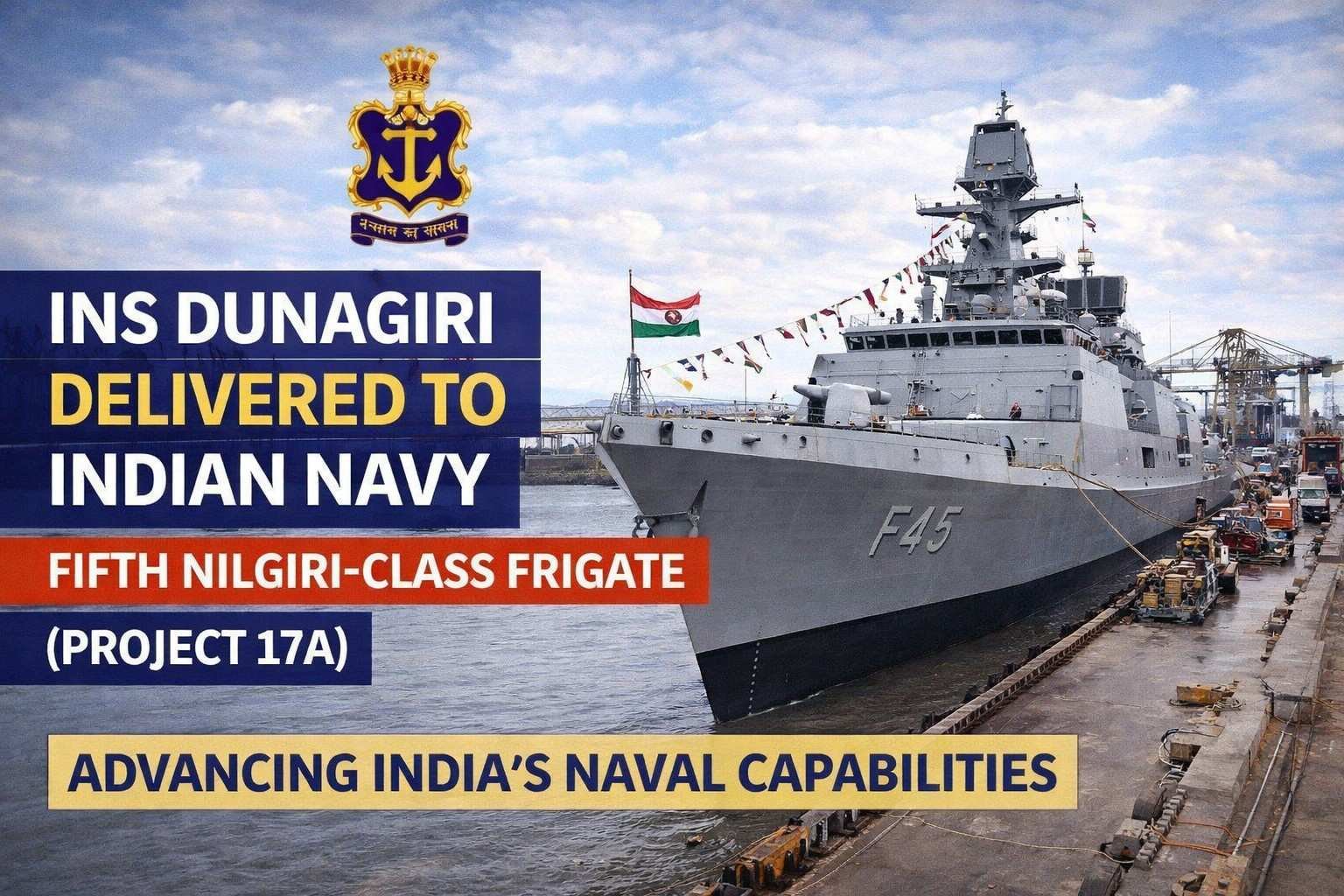
The INS Dunagiri (Yard 3023), the fifth ship of the advanced Nilgiri-class (Project 17A) frigates, was delivered to the Indian Navy on March 30, 2026, at Garden Reach Shipbuilders & Engineers (GRSE) in Kolkata.
This marks a significant milestone in India’s journey towards self-reliance in warship design and construction.
A Modern Multi-Mission Warship
Project 17A frigates are state-of-the-art, multi-role platforms built to tackle both present and future maritime challenges.
The new Dunagiri represents a major advancement in:
- Stealth technology
- Combat capability and firepower
- Automation and survivability
It is also seen as a strong symbol of the government’s Aatmanirbhar Bharat initiative in defence manufacturing.
Legacy of the Original INS Dunagiri
The new warship carries forward the legacy of the earlier INS Dunagiri, a Leander-class frigate that served the Indian Navy from 1977 to 2010, completing 33 years of distinguished service.
Indigenous Design and Construction
The frigate has been:
- Designed by the Warship Design Bureau
- Overseen by the Warship Overseeing Team (Kolkata)
Built using the concept of Integrated Construction, the ship was completed within the planned timeline, reflecting a generational leap in indigenous shipbuilding capabilities.
Advanced Weapons and Technology
Compared to the earlier Shivalik-class (P17) ships, Project 17A frigates come equipped with more advanced systems.
Key Features:
- Propulsion System:
Combined Diesel or Gas (CODOG) setup with diesel engines and gas turbines driving controllable pitch propellers - Weapons & Sensors:
- BrahMos surface-to-surface missile
- MF-STAR radar system
- MRSAM (Medium Range Surface-to-Air Missile) system
- 76 mm Super Rapid Gun Mount (SRGM)
- Close-in weapon systems (30 mm & 12.7 mm)
- Anti-submarine warfare systems including rockets and torpedoes
- Automation:
Equipped with an advanced Integrated Platform Management System (IPMS)
Faster Construction Timeline
Dunagiri is the fifth Project 17A ship delivered in just 16 months.
Notably:
- Construction time reduced to 80 months
- Compared to 93 months for the first ship of the class, INS Nilgiri
This reflects improved efficiency and experience gained from earlier builds.
Boost to Employment and MSMEs
With an impressive 75% indigenous content, the project has:
- Involved over 200 MSMEs
- Generated employment for:
- Around 4,000 people directly
- Over 10,000 people indirectly
Conclusion
The delivery of INS Dunagiri highlights India’s growing strength in naval engineering, design, and shipbuilding. It reinforces the Indian Navy’s commitment to self-reliance while enhancing the country’s maritime security capabilities.