



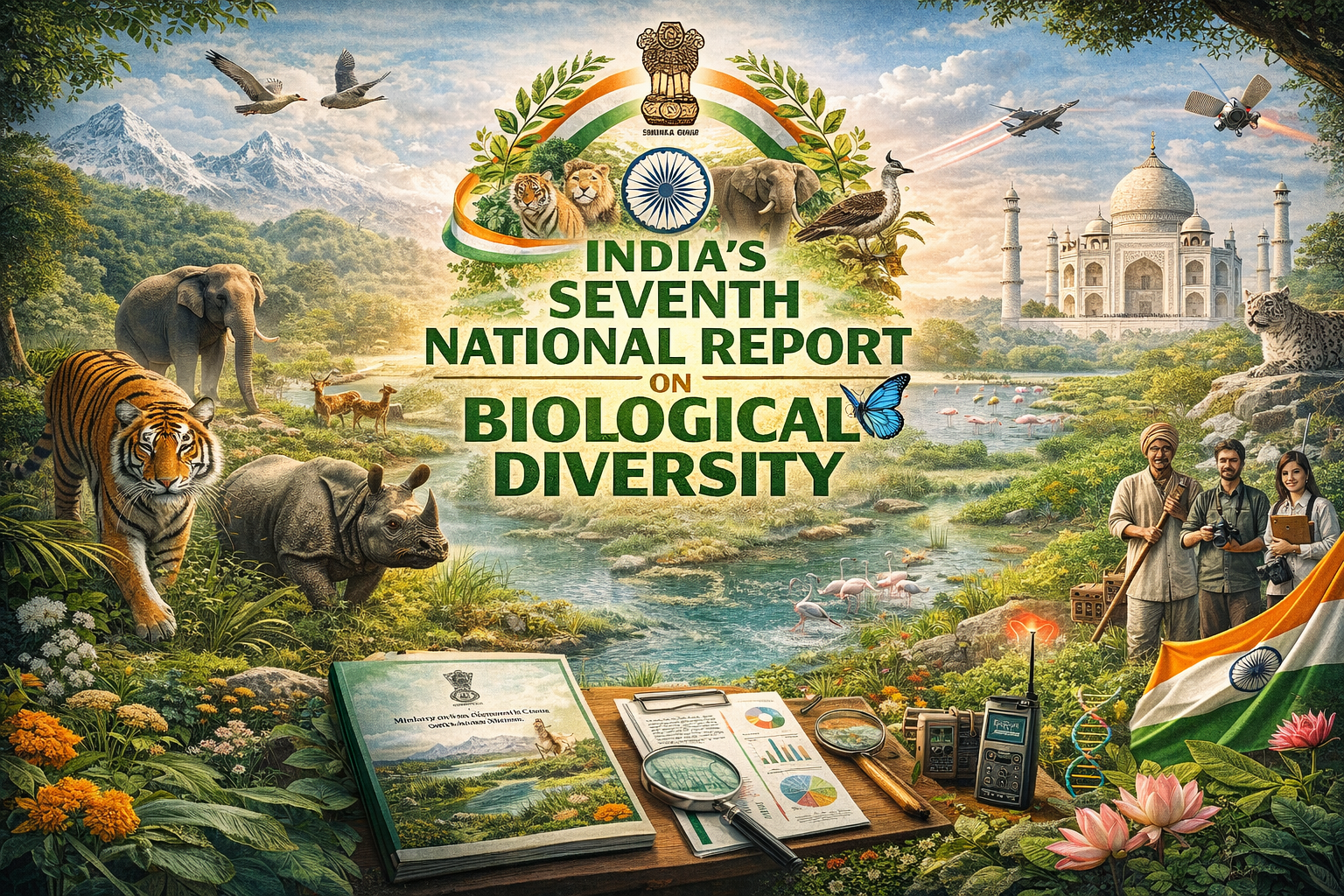
The Ministry of Environment, Forest and Climate Change has submitted India’s Seventh National Report (NR-7) to the Convention on Biological Diversity, reaffirming the country’s commitment to protecting biodiversity and promoting sustainable development.
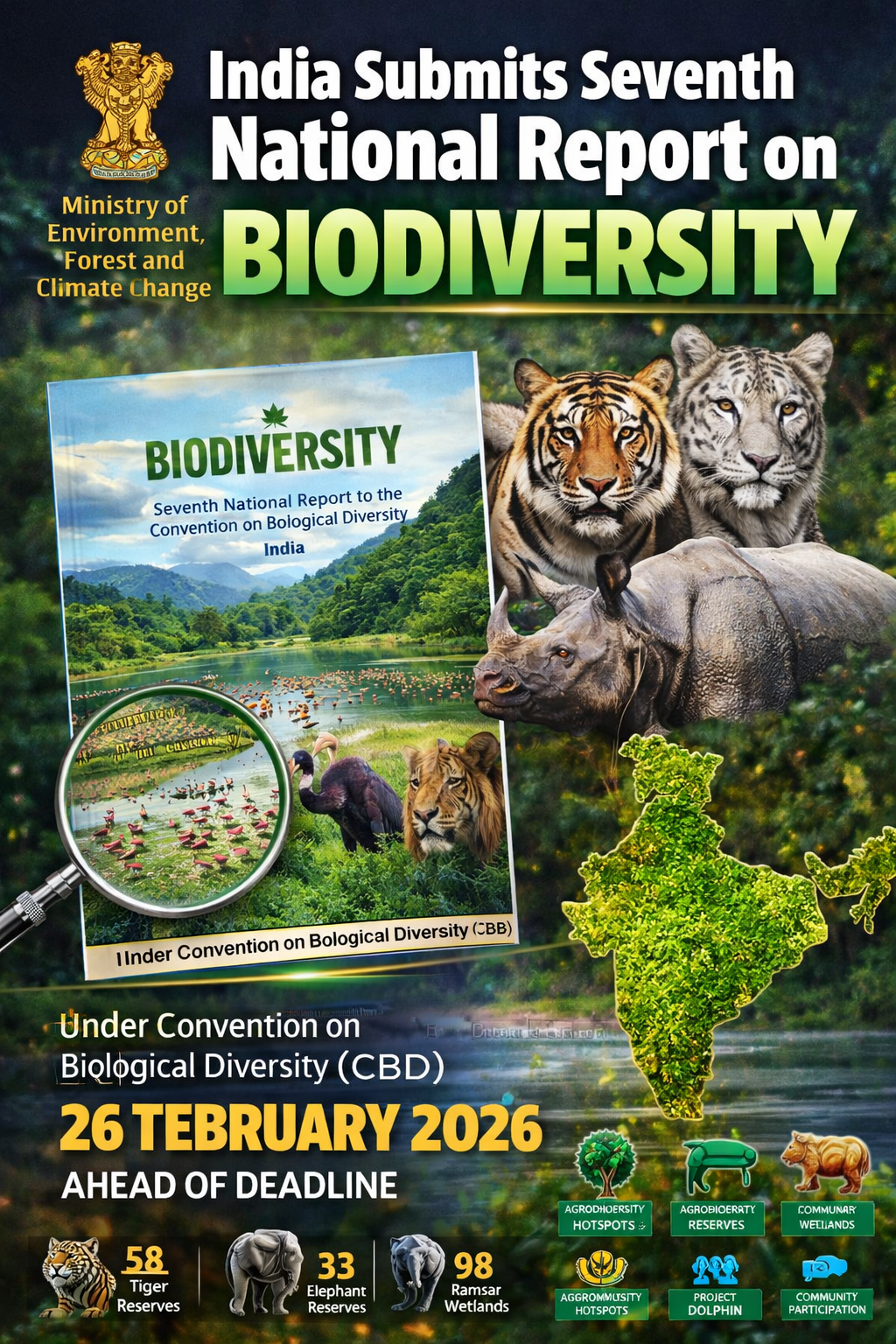

The report highlights India’s progress in achieving global biodiversity goals and outlines the country’s conservation efforts, policy measures, and community participation in protecting natural ecosystems.
Mandatory Reporting Under CBD
Under Article 26 of the Convention on Biological Diversity, all member countries are required to periodically submit national reports describing their progress in implementing biodiversity commitments.
India submitted its Seventh National Report on 26 February 2026, ahead of the official deadline of 28 February 2026, demonstrating its commitment to international environmental obligations.
Alignment With Global Biodiversity Framework
The report provides a comprehensive assessment of India’s biodiversity policies and achievements. It is aligned with:
-
Kunming-Montreal Global Biodiversity Framework
-
National Biodiversity Strategy and Action Plan 2024–2030
India’s assessment is based on 142 national indicators mapped against 23 National Biodiversity Targets (NBTs). According to the report, all 23 targets are currently on track to be achieved.
The report reflects inputs from 33 Central ministries, state governments, research institutions, and other stakeholders, demonstrating a “whole-of-government” and “whole-of-society” approach to biodiversity conservation.
Forest Cover and Wetland Expansion
India has made notable progress in expanding forest and ecological areas.
-
Recorded forest area: 7,75,377 sq km (23.59% of India’s geographical area)
-
Forest cover: 5,20,365 sq km
-
Total forest and tree cover: 8,27,356.95 sq km (25.17%)
The number of Ramsar Convention wetlands in India has increased significantly from 26 in 2014 to 98 in 2026.
Expansion of Protected Areas
India’s wildlife conservation network has expanded substantially and now includes:
-
58 Tiger Reserves
-
33 Elephant Reserves
-
18 Biosphere Reserves
-
106 National Parks
-
574 Wildlife Sanctuaries
India also supports major wildlife populations, including:
-
3,682 tigers (over 70% of the global tiger population)
-
4,014 greater one-horned rhinoceroses
-
22,446 wild elephants
-
891 Asiatic lions
-
718 snow leopards, estimated under the Snow Leopard Population Assessment in India (SLPAI).
Under Project Dolphin, India conducted its first nationwide river dolphin population survey, which estimated 6,327 river dolphins.
Conservation of Agricultural Biodiversity
India has identified 22 agrobiodiversity hotspots and prioritized conservation of 769 Crop Wild Relatives (CWRs) across 171 native crops and 230 indigenous animal breeds. These efforts aim to protect genetic diversity important for agriculture and food security.
Role of Local Communities
The National Biodiversity Authority has signed more than 5,600 Access and Benefit Sharing (ABS) agreements, distributing around ₹140 crore.
Local communities are also actively involved through:
-
2,76,653 Biodiversity Management Committees (BMCs)
-
2,72,648 People’s Biodiversity Registers (PBRs)
These initiatives help document traditional knowledge and encourage biodiversity-friendly practices.
Legal and Technological Support for Conservation
India’s biodiversity conservation framework is supported by several key environmental laws, including:
-
Indian Forest Act 1927
-
Wildlife Protection Act 1972
-
Environment Protection Act 1986
-
Biological Diversity Act 2002
India also uses advanced technologies such as remote sensing, GIS mapping, satellite telemetry, unmanned aerial vehicles (UAVs), camera traps, and DNA-based tools to monitor forests and wildlife populations.
Digital Governance and Public Participation
To improve environmental governance, the government has launched PARIVESH Portal, which provides a transparent digital platform for environmental approvals.
The report also highlights public participation initiatives such as:
-
Mission LiFE
-
“Ek Ped Maa Ke Naam” tree plantation campaign
These initiatives encourage citizens to adopt sustainable lifestyles and contribute to environmental conservation.
Conclusion
India’s Seventh National Report presents a comprehensive evaluation of the country’s biodiversity conservation efforts. It demonstrates measurable progress in ecosystem protection, wildlife conservation, sustainable resource use, governance reforms, and community participation.
The report reaffirms India’s commitment to achieving global biodiversity targets by 2030 under the Kunming-Montreal Global Biodiversity Framework while ensuring sustainable development and ecological balance.