

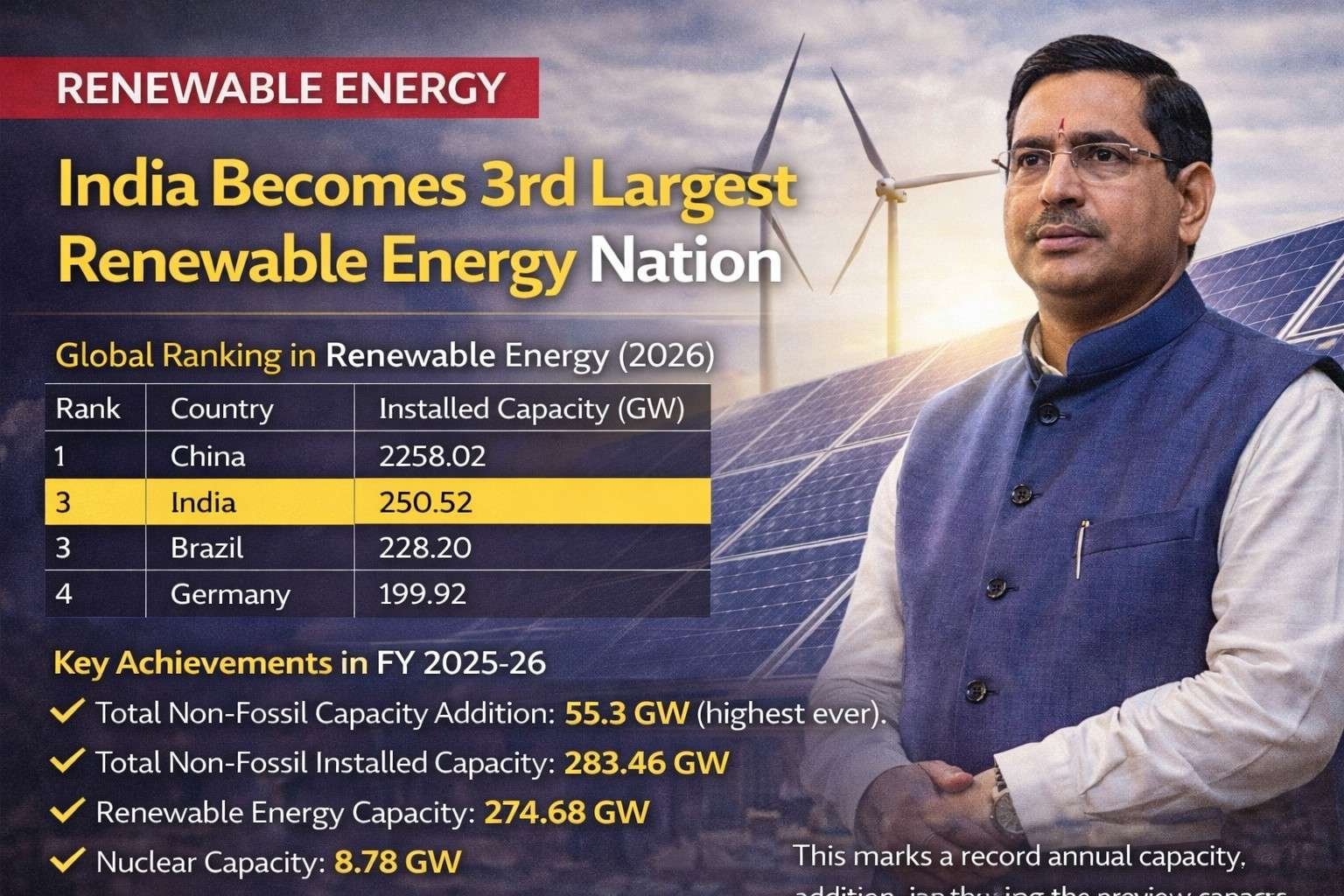
India has emerged as the third-largest country in the world in terms of Renewable Energy Installed Capacity, surpassing Brazil, according to the Renewable Energy Statistics 2026 released by the International Renewable Energy Agency.
Union Minister Pralhad Joshi announced this achievement, highlighting India’s rapid progress in clean energy.
Global Ranking in Renewable Energy (2026)
| Rank | Country | Installed Capacity (GW) |
|---|---|---|
| 1 | China | 2258.02 |
| 2 | USA | 467.92 |
| 3 | India | 250.52 |
| 4 | Brazil | 228.20 |
| 5 | Germany | 199.92 |
India’s rise to the 3rd position reflects its strong policy push and investment in renewable energy.
Key Achievements in FY 2025–26
- Total Non-Fossil Capacity Addition: 55.3 GW (highest ever)
- Total Non-Fossil Installed Capacity: 283.46 GW
- Renewable Energy Capacity: 274.68 GW
- Nuclear Capacity: 8.78 GW
This marks a record annual capacity addition, nearly doubling the previous year’s growth.
Record Renewable Energy Share
In July 2025, India achieved a major milestone:
- 51.5% of electricity demand met through renewables
- Total demand: 203 GW
Additionally:
- Non-fossil share in total generation (FY26): 29.2%
- Total power generation: 1845.9 Billion Units (BU)
Ahead of Climate Targets
India achieved:
- 50% installed power capacity from non-fossil sources in June 2025
This milestone was reached 5 years ahead of the 2030 target under:
- Paris Agreement
India now aims to achieve:
- 500 GW non-fossil capacity by 2030 (announced at COP26)
Sector-wise Renewable Capacity (March 2026)
- Solar Power: 150.26 GW
- Wind Energy: 56.09 GW
- Large Hydro: 51.41 GW
- Bio Energy: 11.75 GW
- Small Hydro: 5.17 GW
Massive Growth Since 2014
- Total RE capacity increased 3.59 times (76.38 GW → 274.68 GW)
- Solar capacity surged 53 times (2.82 GW → 150.26 GW)
- Wind capacity grew 2.66 times
This highlights India’s aggressive push toward clean energy transition.
Role of Distributed Renewable Energy (DRE)
- 16.3 GW added through distributed solar
- Accounts for 36% of total additions
Includes:
- Rooftop Solar: 8.7 GW
- PM KUSUM Scheme: 7.6 GW
Wind Energy Milestone
- 6.05 GW wind capacity added in FY26
- Highest-ever annual addition
Boost to Domestic Manufacturing
- Solar module capacity: 2.3 GW → 172 GW
- Wind turbine capacity: 10 GW → 24 GW
This supports the Atmanirbhar Bharat initiative by reducing import dependence.
Key Policy Measures by Government
Major reforms introduced by the Ministry of New and Renewable Energy:
- GST reduced on renewable equipment (12% → 5%)
- Custom duty exemption for lithium-ion battery manufacturing
- Launch of Renewable Energy Equipment Import Monitoring System (REEIMS)
- Introduction of Virtual Power Purchase Agreements (VPPA)
- Contract for Difference (CfD) scheme for RE projects
- National Geothermal Energy Policy (2025)
- Revised Quality Control Order (QCO 2025)
Conclusion
India’s rise to the third position globally in renewable energy capacity reflects its strong commitment to clean energy, climate goals, and sustainable growth. With rapid expansion in solar, wind, and distributed energy, along with supportive policy measures, India is well on track to become a global leader in renewable energy.