

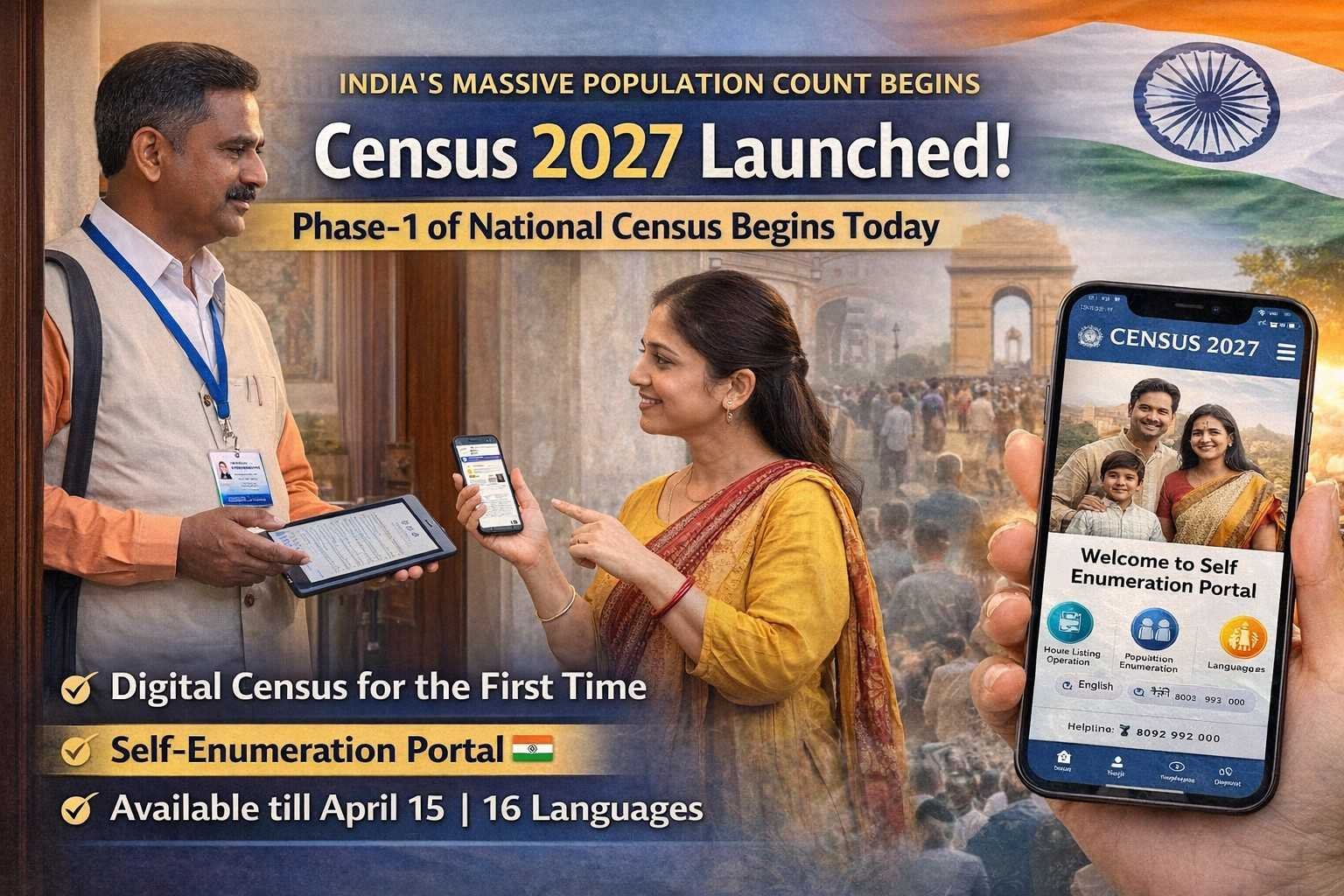
India has officially launched the first phase of Census 2027, marking the beginning of the world’s largest population enumeration exercise. This will be the 16th Census overall and the 8th since Independence, continuing a long-standing national tradition of data collection and planning.
Two-Phase Census Process
The Census will be conducted in two major phases:
- House Listing Operation (HLO)
- Population Enumeration (PE)
The reference date for most parts of the country has been fixed as March 1, 2027. However, for snow-bound regions like Ladakh, Jammu and Kashmir, Himachal Pradesh, and Uttarakhand, the reference date will be October 1, 2026.
Digital Census for the First Time
In a major technological shift, Census 2027 will be conducted digitally for the first time.
- Citizens can use a Self-Enumeration (SE) portal
- Available from today till 15th April
- Accessible in 16 languages
This secure web-based platform allows individuals to enter their own details online before the traditional door-to-door survey begins.
House Listing Phase Begins from April 16
The House Listing and Housing Census will be carried out from:
- April 16 to May 15
During this phase, officials will:
- List all buildings and structures
- Collect data on:
- Housing conditions
- Amenities
- Assets
- Conduct geo-tagging of buildings
- Assign a unique identification number to each structure
States Participating in First Phase
A total of 11 States and Union Territories will initially undertake the House Listing process, including:
- Andaman and Nicobar Islands
- Goa
- Karnataka
- Lakshadweep
- Mizoram
- Odisha
- Sikkim
- NDMC area
- Delhi Cantonment Board
Second Phase: Population Enumeration
The Population Enumeration phase will be conducted in February 2027, during which detailed demographic data will be collected.
Importantly, caste enumeration will also be included in this phase.
Budget and Data Security
The Central Government has approved an outlay of over ₹11,718 crore for conducting Census 2027.
Mritunjay Kumar Narayan has assured that:
- Strong data security measures are in place
- Citizens’ information will remain safe and confidential
He has also urged people to provide accurate and truthful information to ensure reliable data collection.
Conclusion
Census 2027 marks a major step forward with digital innovation, aiming to make the process more efficient, transparent, and accessible. The data collected will play a crucial role in policy-making, development planning, and resource allocation across the country.