

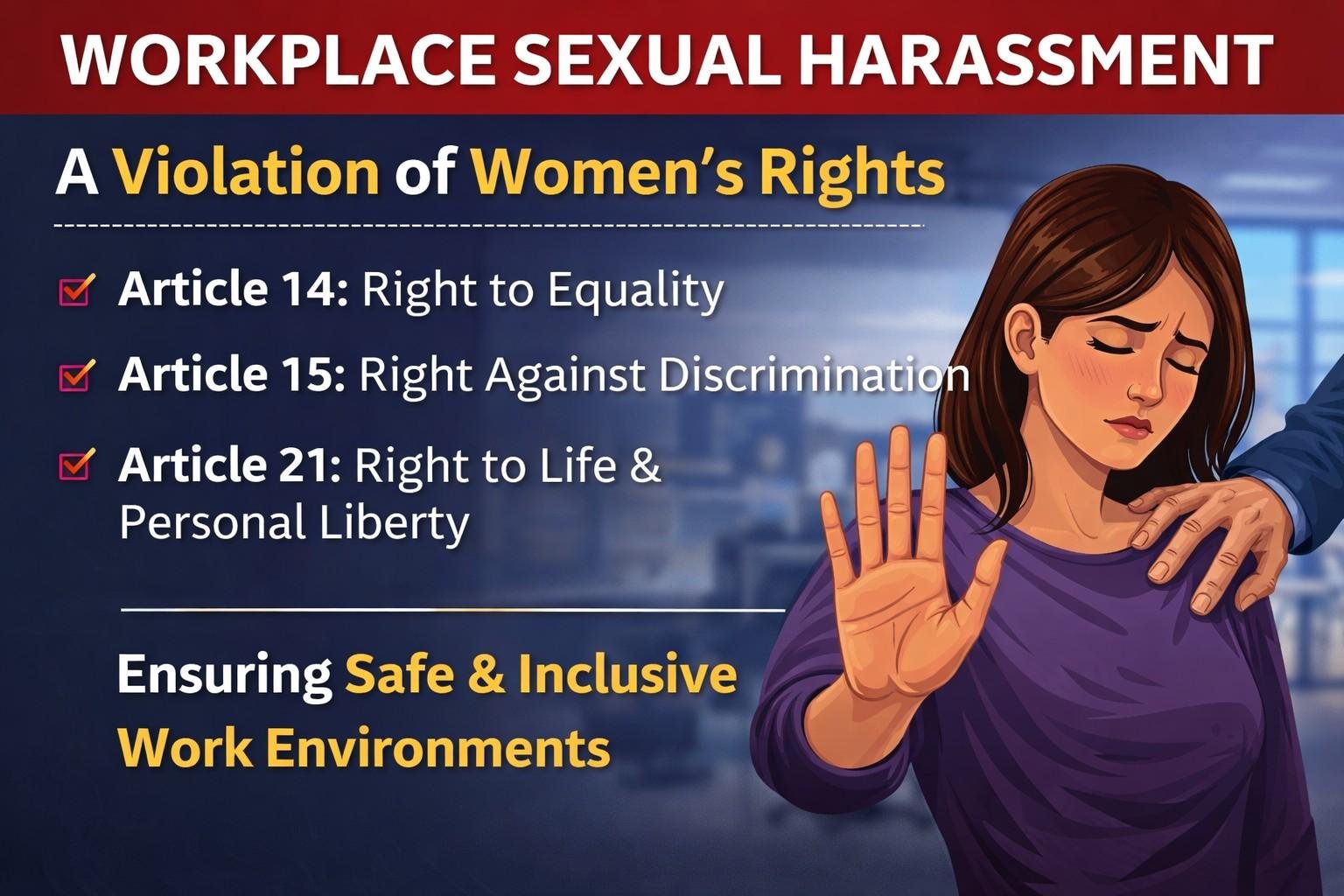
Sexual harassment at the workplace is not just a social issue—it is a serious violation of women’s fundamental rights guaranteed under the Constitution of India. It infringes upon the rights to equality (Article 14), non-discrimination (Article 15), and life and personal liberty (Article 21), along with the right to practice any profession under Article 19(1)(g), which includes the right to a safe working environment.
Such harassment creates an unsafe and hostile work atmosphere, discouraging women’s participation in the workforce and affecting their economic empowerment. Addressing this issue is essential for achieving inclusive growth and gender equality.
The Legal Framework: SH Act, 2013
To tackle this issue, the Government of India enacted the Sexual Harassment of Women at Workplace (Prevention, Prohibition and Redressal) Act, 2013.
The Act aims to:
- Provide a safe and secure working environment
- Prevent and prohibit sexual harassment
- Ensure effective redressal mechanisms
Importantly, the law is inclusive and wide-ranging, covering women across all sectors—whether employed or not, and whether in the formal or informal economy.
Who is Protected Under the Law?
1. Aggrieved Woman
Under Section 2(a), an “aggrieved woman” includes any woman of any age, whether employed or not, who alleges sexual harassment at a workplace.
This ensures protection even for:
- Visitors
- Clients
- Domestic workers
2. Employee
Section 2(f) defines “employee” broadly to include:
- Permanent and temporary workers
- Contractual employees
- Trainees, apprentices, and interns
- Volunteers and even unpaid workers
This means protection is not limited by employment status or salary.
3. Employer
Section 2(g) defines “employer” as any person responsible for managing or supervising the workplace. This includes:
- Heads of government departments
- Private sector management
- Contractors
- Even households employing domestic workers
4. Workplace
Under Section 2(o), “workplace” has been given a very wide meaning, covering:
- Government and private offices
- NGOs and institutions
- Hospitals, educational institutions, and industries
- Homes (for domestic workers)
- Any place visited during the course of employment
This ensures that women are protected even while travelling for work or working remotely.