



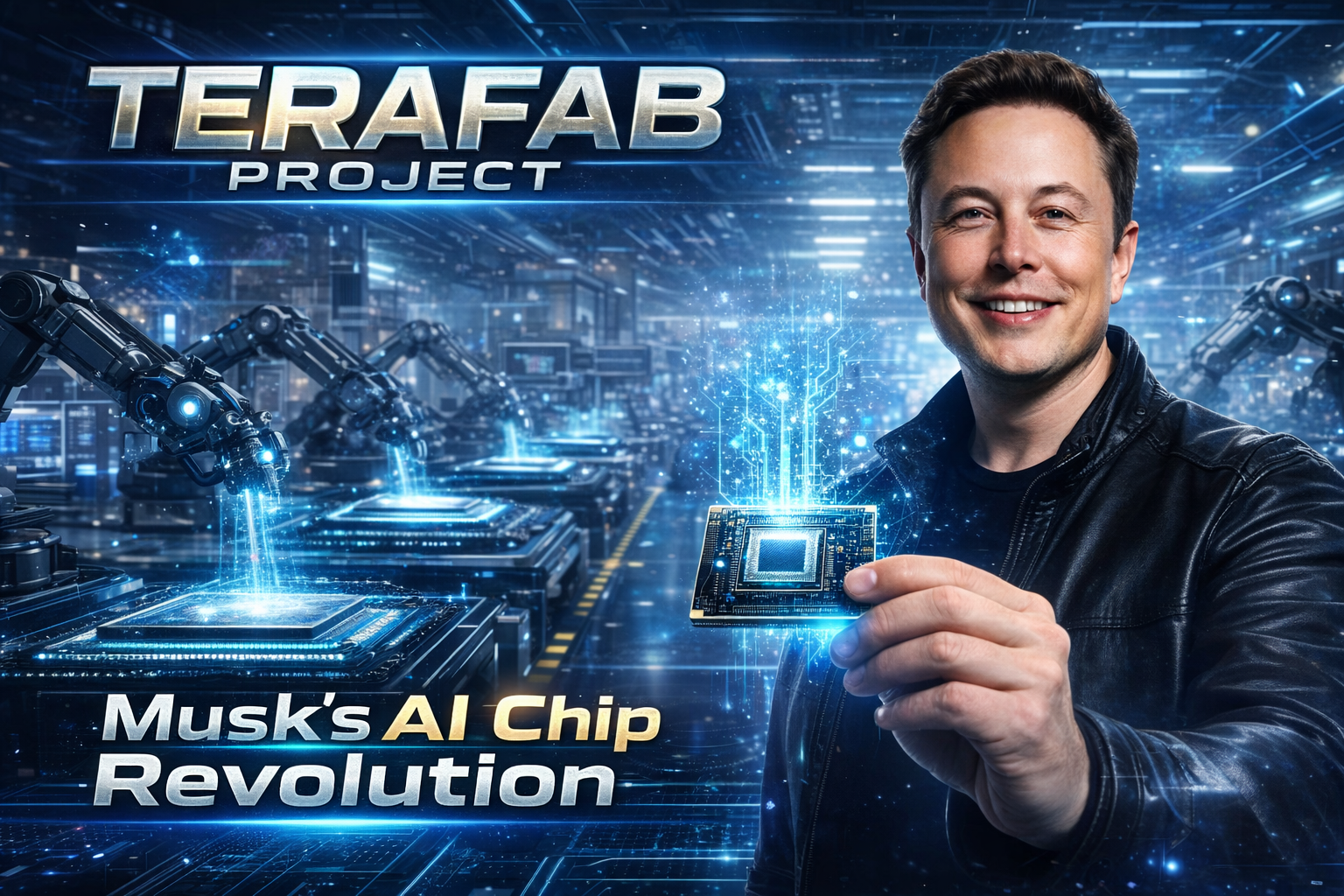
- Elon Musk has launched a new project called ‘Terafab’ to manufacture advanced AI chips.
- It is a joint initiative of Tesla, SpaceX, and the AI firm xAI.
- This version keeps the structure tight, ensures proper grammar, and highlights the key details (location, scale, and collaboration).
Key Facts About Terafab:
- Cost: Estimated $20–25 billion, making it one of the largest semiconductor investments globally.
- Partners: Tesla, SpaceX, and xAI — Musk’s three companies collaborating for the first time on a vertically integrated AI hardware venture.
- Output Goal: 1 terawatt (1 trillion watts) of AI compute per year, far exceeding any single semiconductor site worldwide.
- Technology: Targeting 2-nanometre silicon fabrication, advanced packaging, memory production, and testing — all consolidated under one roof.
Terafab is not just another semiconductor fab — it’s a moonshot project to centralize AI chip production at unprecedented scale, blending Musk’s automotive, aerospace, and AI ambitions. If successful, it could redefine global semiconductor power dynamics and make Austin the epicenter of next-generation AI hardware.
- Reduce dependence on existing chip manufacturers
- Accelerate AI development
- Lower production costs in the long term
Industry Impact:
The semiconductor industry is already highly competitive, with major players investing heavily in AI hardware. Musk’s entry into this space could disrupt the market and push innovation further.
Future Implications:
If successful, Terafab could:
- Boost AI research and applications
- Strengthen technological independence
- Drive next-generation computing advancements
Conclusion:
Elon Musk’s Terafab project signals a bold step into the AI hardware space, potentially reshaping the future of computing and artificial intelligence.