



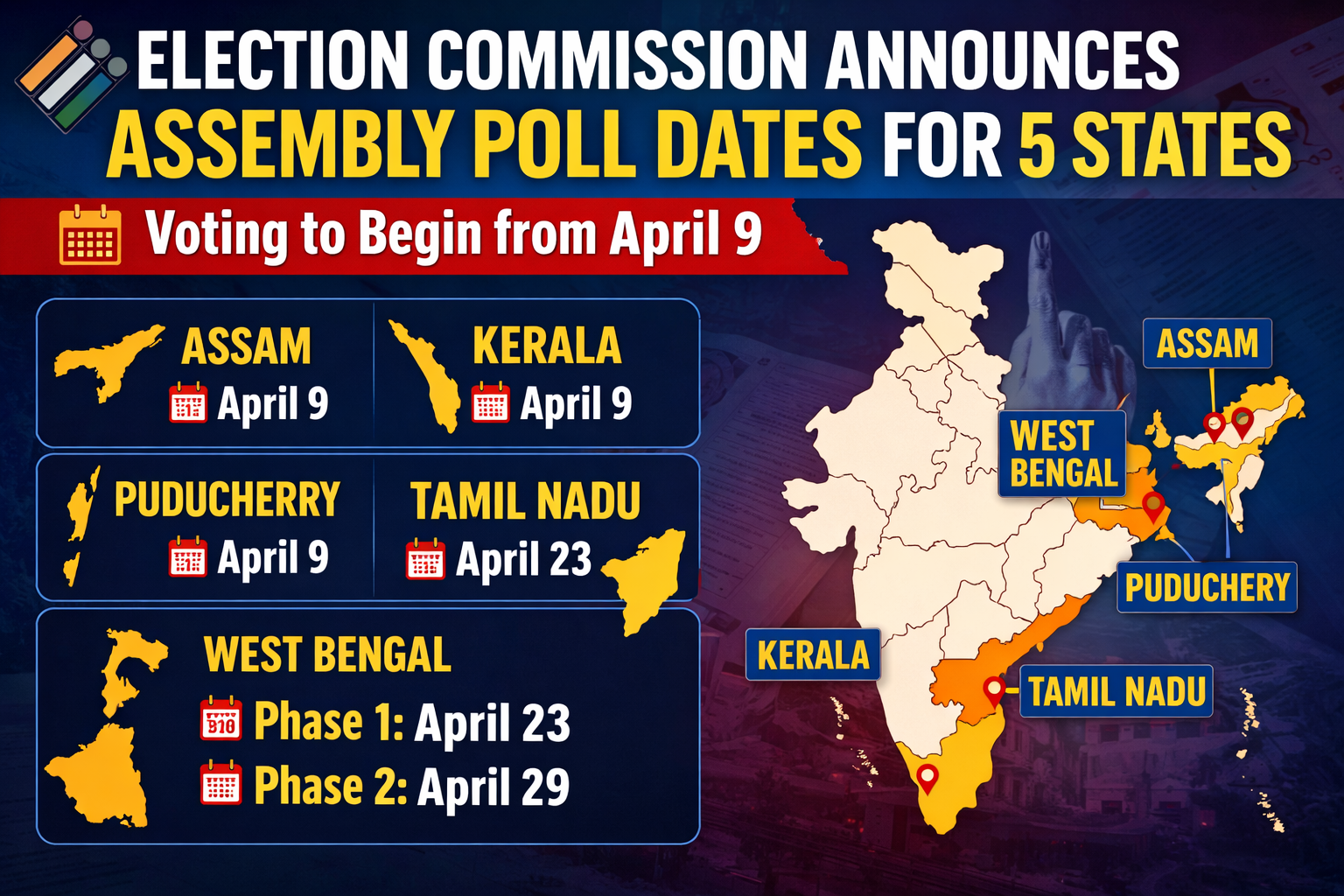
The Election Commission of India has announced the schedule for upcoming assembly elections in four states and one Union Territory. Polling will be conducted on different dates in Assam, Kerala, Puducherry, Tamil Nadu, and West Bengal.
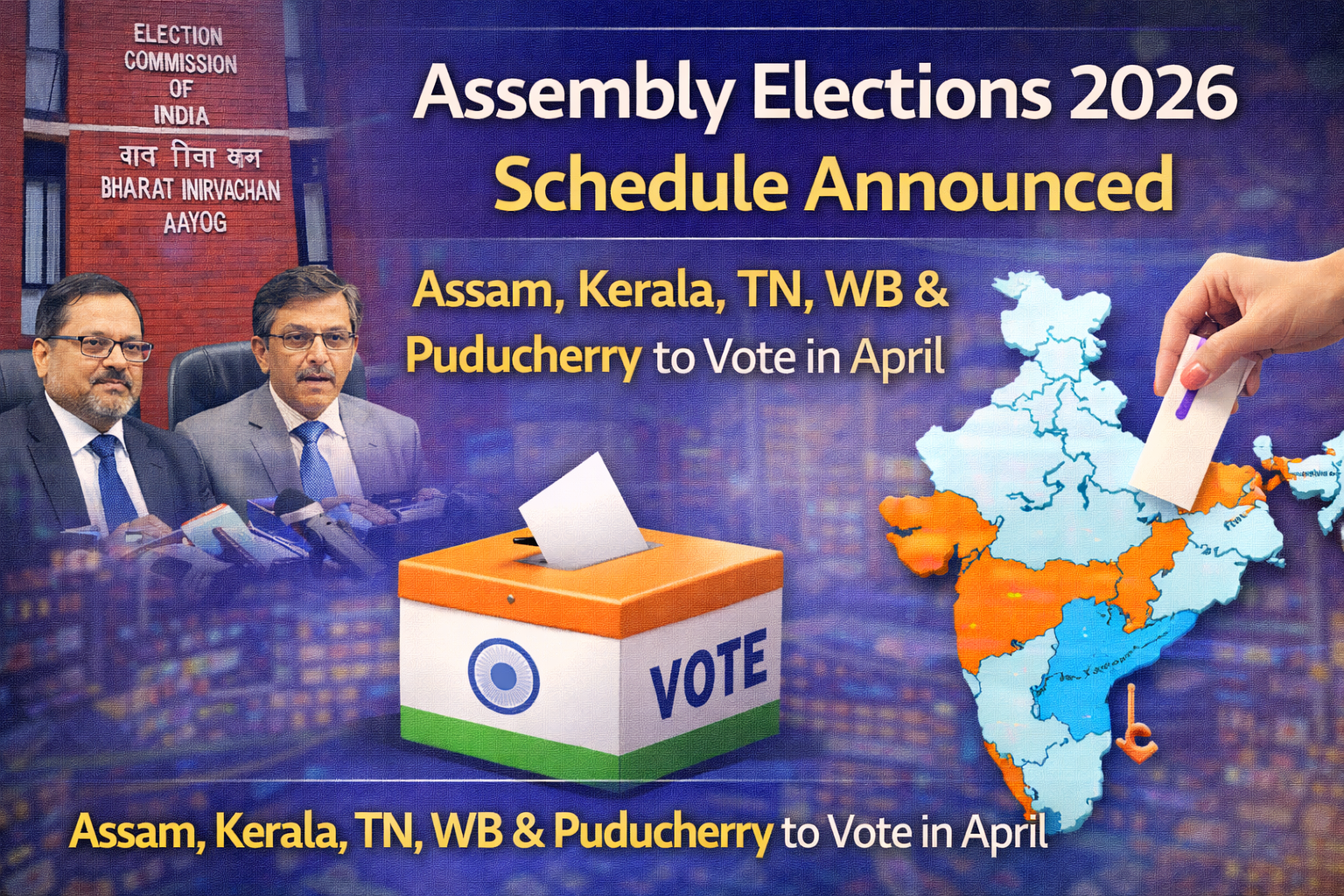
- The polling in Assam, Kerala, and Puducherry will take place on April 9, while Tamil Nadu will go to polls on April 23.
- Elections in West Bengal will be conducted in two phases on April 23 and April 29.
Counting of Votes
- The Election Commission of India also announced that the counting of votes will take place on May 4.
- In total, elections will be conducted for 824 assembly seats across the four states and the Union Territory.
Model Code of Conduct in Force
With the announcement of the election schedule, the Model Code of Conduct has come into immediate effect. The Election Commission emphasized that the elections must remain free, fair, and peaceful, warning that strict action will be taken against any attempt to influence voters through inducements or violence.
Assembly Seat Details
-
Tamil Nadu has 234 assembly seats. The state is currently governed by M. K. Stalin, who has been in office since May 7, 2021.
-
West Bengal has 294 assembly seats and is led by Mamata Banerjee, whose party has been in power since 2011.
-
Kerala has 140 assembly seats, with Pinarayi Vijayan heading the Left Democratic Front (LDF) government since 2016.
-
Assam has 126 assembly seats. The state has been ruled by the Bharatiya Janata Party (BJP) since 2016, and Himanta Biswa Sarma has been the Chief Minister since 2021.
-
The Union Territory of Puducherry has 33 assembly seats, including three members nominated by the Centre. The current Chief Minister is N. Rangasamy, who has been in power since 2021.
Constitutional Provisions Related to the Election Commission
The Election Commission of India is an independent constitutional body responsible for administering elections in India. It was established under Article 324 of the Constitution of India, which grants it the authority to supervise, direct, and control elections to Parliament, state legislatures, and the offices of the President and Vice-President.
Some important constitutional provisions related to elections include:
-
Article 324 – Provides powers and functions of the Election Commission.
-
Article 325 – Ensures that no person is excluded from electoral rolls on grounds of religion, race, caste or sex.
-
Article 326 – Establishes universal adult franchise for citizens aged 18 years and above.
-
The present Chief Election Commissioner is Gyanesh Kumar and other two Election Commissioners are Sukhbir Singh Sandhu and Vivek Joshi.