




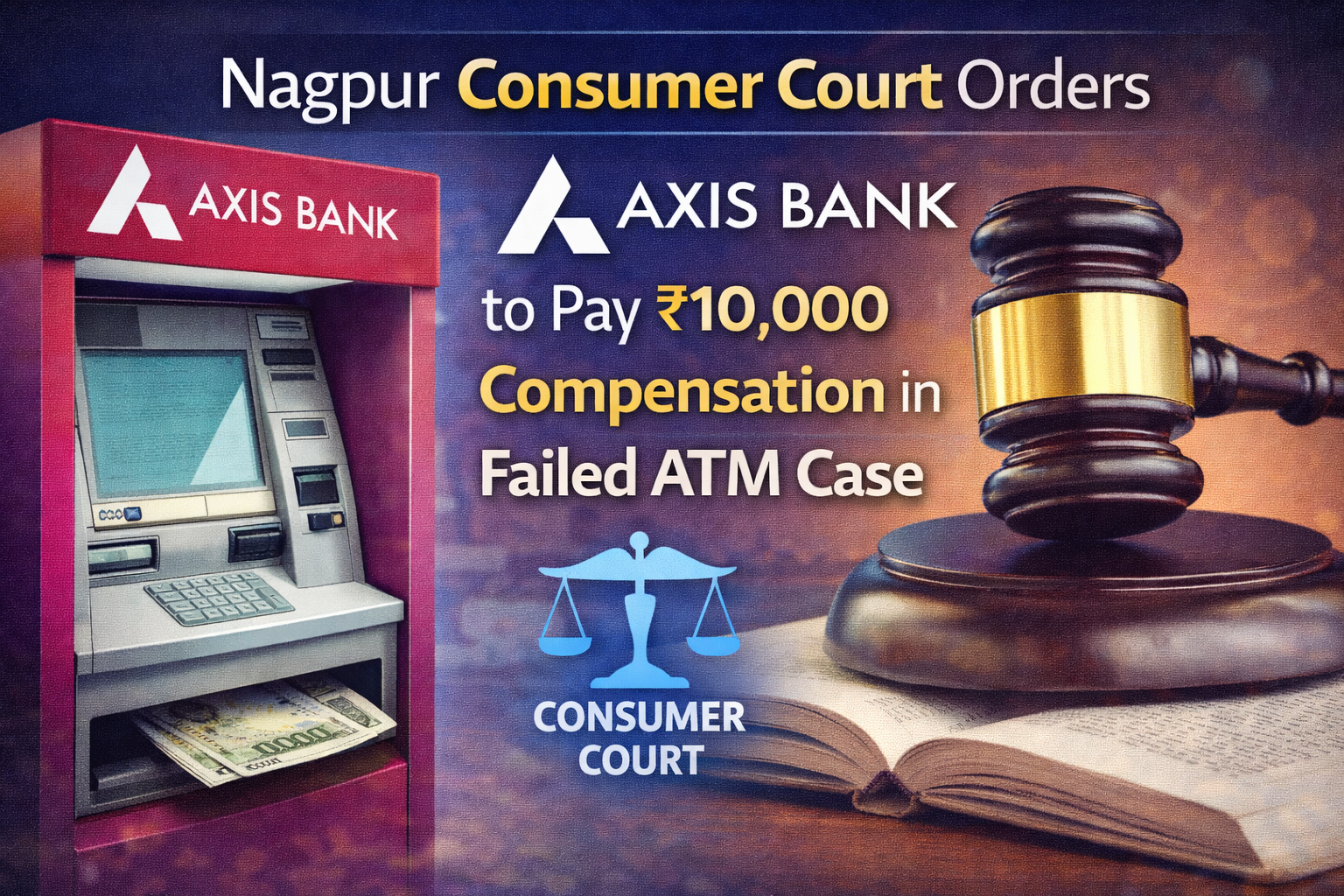
The District Consumer Disputes Redressal Commission in Nagpur, Maharashtra, has pulled up Axis Bank for “deficiency in service” in a case involving a failed ATM transaction. The commission directed the bank to refund ₹5,000 and pay ₹10,000 as compensation to the affected customer.
Background of the Case
The incident dates back to August 19, 2018, when a Nagpur resident attempted to withdraw ₹5,000 from an Axis Bank ATM. According to the complainant, the ATM machine did not dispense any cash, but the amount was still debited from his account in Central Bank of India.
Despite immediately reporting the issue and repeatedly contacting customer care and the bank’s head office, the problem was not resolved. The bank later claimed that the transaction had been successful and eventually closed the complaint in October 2024, calling the claim “false.”
Commission’s Observations
The matter was heard by the Additional District Consumer Disputes Redressal Commission in Nagpur. The case was handled ex parte after Axis Bank failed to appear before the commission even after receiving a legal notice.
The commission noted that the bank failed to present any evidence of conducting a proper inquiry or CCTV verification to determine what actually happened during the ATM transaction.
Commission’s Verdict
The commission held that the non-receipt of cash despite the deduction of money from the customer’s account is a serious matter and clearly reflects deficiency in service by the bank.
It further observed that the bank did not take the customer’s complaints seriously and even failed to submit any supporting documents or evidence before the commission.
As a result, the commission ordered Axis Bank to:
-
Refund ₹5,000 to the complainant
-
Pay ₹10,000 as compensation for mental and physical harassment
Significance of the Ruling
The ruling highlights the responsibility of banks to promptly address ATM-related grievances and ensure transparency in handling customer complaints. It also reinforces the role of consumer protection bodies in safeguarding the rights of bank customers in cases of service deficiency.