



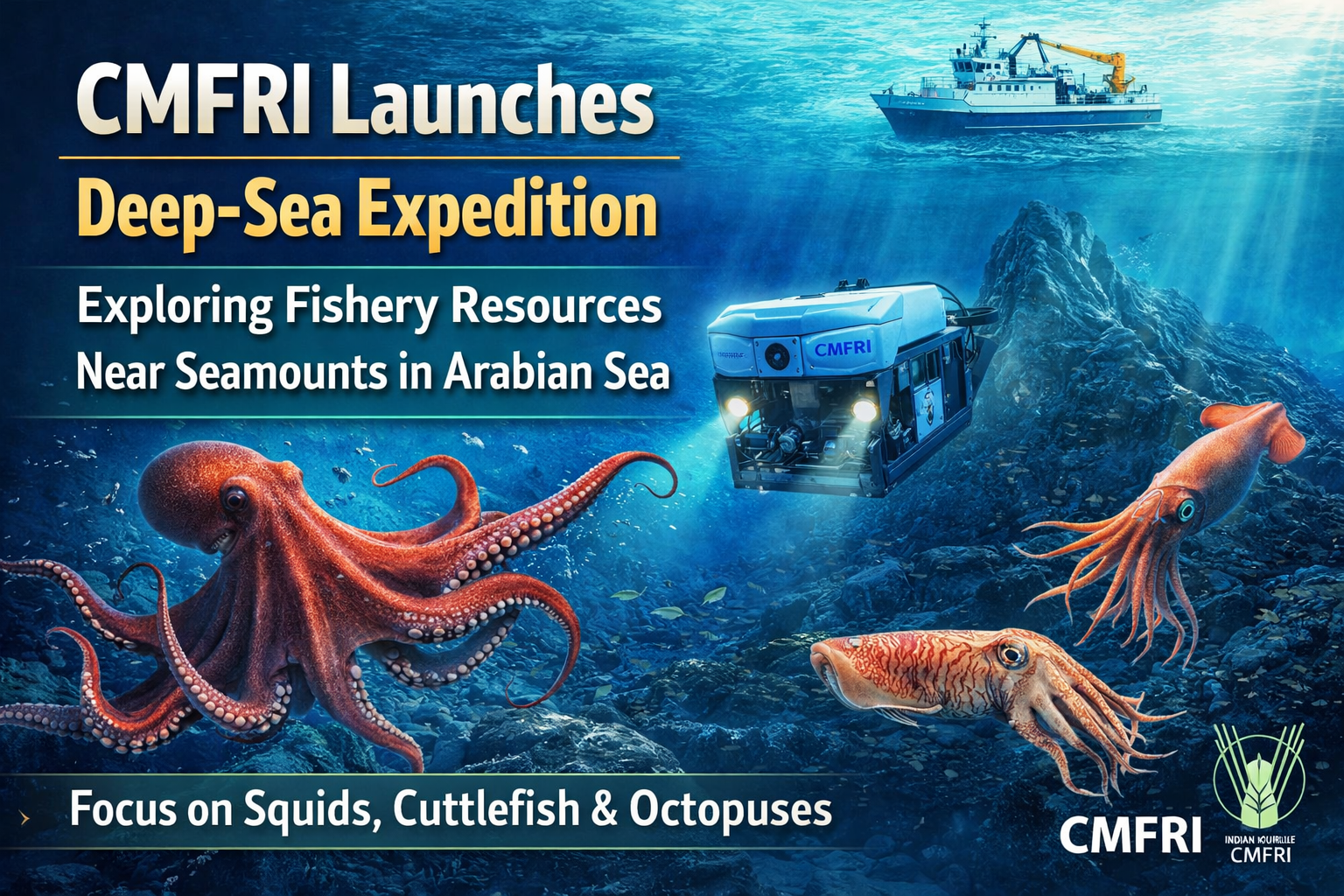
The Central Marine Fisheries Research Institute (CMFRI), operating under the Indian Council of Agricultural Research, has launched a deep-sea expedition to explore fishery resources associated with seamount ecosystems in the Arabian Sea.
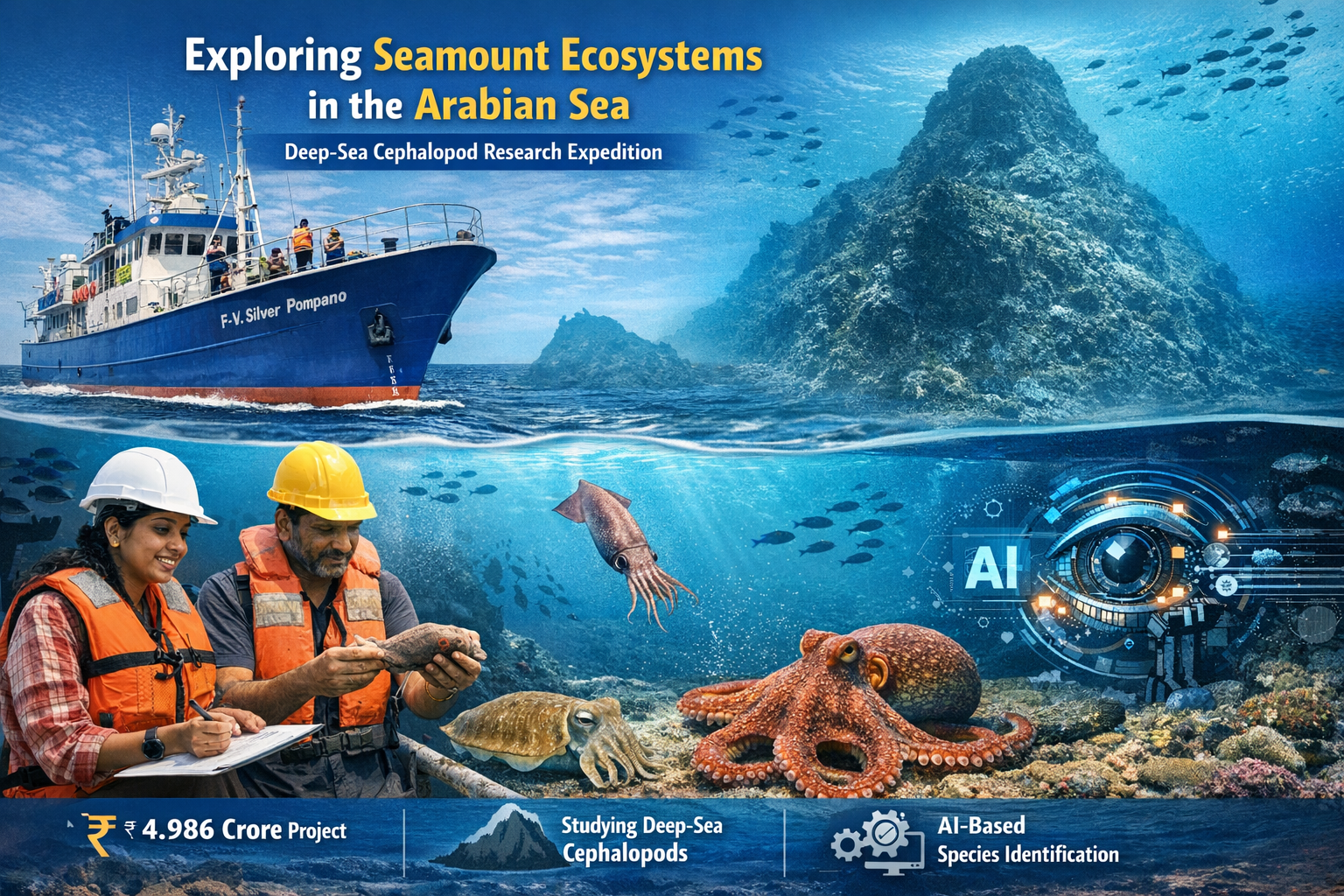
The research will focus particularly on cephalopods, including squids, cuttlefish and octopuses, which are important components of deep-sea biodiversity and marine fisheries.
Project Details
- The two-year research project is funded by the Ministry of Earth Sciences with a total budget of ₹4.986 crore.
- Its main objective is to study the diversity, ecology, distribution and biological characteristics of cephalopods inhabiting seamount regions in the eastern Arabian Sea.
- In addition to field studies, researchers will develop AI-based tools to automatically identify different species of squid, cuttlefish and octopus. This technological integration is expected to significantly improve scientific understanding of deep-sea biodiversity.
Collaboration and Mission
- The project is being conducted by CMFRI’s Kochi headquarters and its Mangaluru Regional Centre in collaboration with the National Institute of Technology Surathkal.
- It is part of Vertical-3 of the Deep Ocean Mission, a major national programme aimed at exploring and sustainably utilizing ocean resources.
First Exploratory Survey
- The first exploratory survey targeting selected seamounts in the southeastern Arabian Sea was carried out aboard the research vessel F.V. Silver Pompano, operating from Kochi.
- The expedition was led by Divya Viswambharan, Senior Scientist at CMFRI, along with Kavitha M.
- At the same time, another research team headed by V. Venkatesan, Principal Scientist at CMFRI, conducted parallel sampling operations aboard a fishing vessel from Azheekal Fishing Harbour.
Importance of the Study
- The survey aims to document cephalopod assemblages associated with seamount habitats. Seamount ecosystems are known to host rich marine biodiversity and play an important role in sustaining fishery resources.
- According to Geetha Sasikumar, the Principal Investigator of the project, the findings will provide valuable insights into the ecology and diversity of deep-sea cephalopods.
- The research outcomes are expected to help scientists and policymakers develop sustainable conservation strategies for seamount-associated fisheries, while also enhancing India’s understanding of deep-sea ecosystems.