

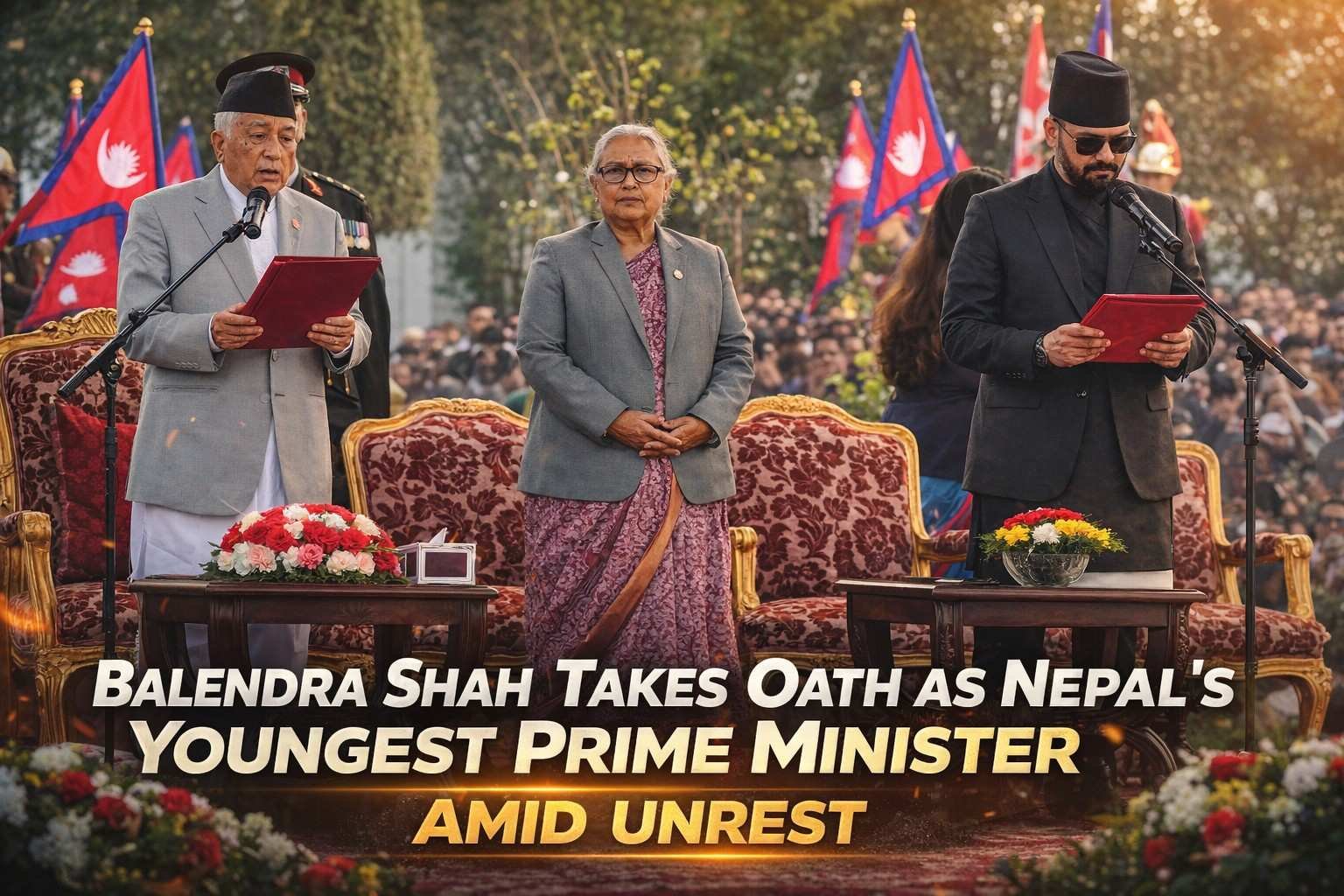
- Rapper-turned-politician Balendra Shah (35 years old) became Nepal’s youngest prime minister, following a decisive victory by his Rastriya Swatantra Party in the March 5 elections.
- He took the oath of office from President Ram Chandra Paudel, marking a significant moment in Nepal’s political landscape as he assumes leadership amidst widespread dissatisfaction with traditional political parties, which have faced accusations of corruption and instability.
- His appointment comes after a youth-led uprising that resulted in the ousting of the previous government in September.
- This development is considered significant because the Madhesh region has long demanded greater political representation in the national government of Nepal.
Landslide Victory in the 2026 Elections:
- Nepal held parliamentary elections on 5 March 2026 to elect members of the 275-seat House of Representatives.
- 165 seats were chosen by direct elections (FPTP).
- 110 seats were filled through proportional representation.
- Balen Shah’s party, the Rastriya Swatantra Party (RSP), secured a massive win in the parliamentary elections.
- The party won 125 out of 165 directly elected seats in Nepal’s House of Representatives.
- It also led in many seats under the proportional representation system, giving it a strong chance to form the government.
- This is one of the largest victories in Nepal’s democratic history, breaking the long dominance of traditional parties.
Key Direct Election Results:
- Balendra Shah (RSP)
- Defeated former Prime Minister K.P. Sharma Oli in Jhapa Constituency-5.
- Won with 68,348 votes, compared to Oli’s 18,734 votes.
- Margin of victory: 49,614 votes.
Direct Election Results (165 Seats)
| Party | Seats Won |
|---|---|
| Rastriya Swatantra Party (RSP) | 125 |
| Nepali Congress (NC) | 18 |
| Communist Party of Nepal (UML) | 9 |
| Nepali Communist Party (NCP) | 8 |
| Shram Sanskriti Party | 3 |
| Rastriya Prajatantra Party (RPP) | 1 |
| Independent | 1 |
Rastriya Swatantra Party (RSP):
- Direct seats won: 125 out of 165.
- Proportional representation seats: 57 out of 110.
- Total seats: 182 out of 275 (just two short of a two-thirds majority).
Why the 2026 Election is Historic:
The election is considered a milestone because:
- It shows a generational shift in Nepal’s politics, with younger leaders gaining power.
- Voters expressed frustration with traditional political parties and supported reform-oriented leadership.
- It reflects growing demands for transparency, anti-corruption measures, and better governance.
Who is Balen Shah?
- Full Name: Balendra Shah (popularly known as Balen Shah)
- Date of Birth: 27 April 1990
- Nationality: Nepal
- Profession: Structural Engineer, Rapper, Politician
- Political Role: Former Mayor of Kathmandu.
Early Life and Education:
- Balen Shah was born and raised in Kathmandu.
- He studied Civil Engineering and later specialized in Structural Engineering.
- Before entering politics, he worked as an engineer and also gained popularity as a Nepali rapper, releasing songs focused on social and political issues.
Political Career:
- As the Mayor of Kathmandu, Balen Shah gained attention for taking strict action on illegal constructions, improving waste management, and introducing administrative reforms in the city.
- His leadership style and popularity among youth made him one of the most influential young political figures in Nepal.
Why This Development Matters
- It would make Balen Shah one of the youngest leaders to hold Nepal’s top political office.
- The move could strengthen political representation for the Madhesh region.
- It reflects a changing political landscape in Nepal, where new leaders and ideas are gaining support.
Don’t Miss Daily GK Updates!
Get the latest current affairs directly in your inbox..
No spam. Only important updates.