

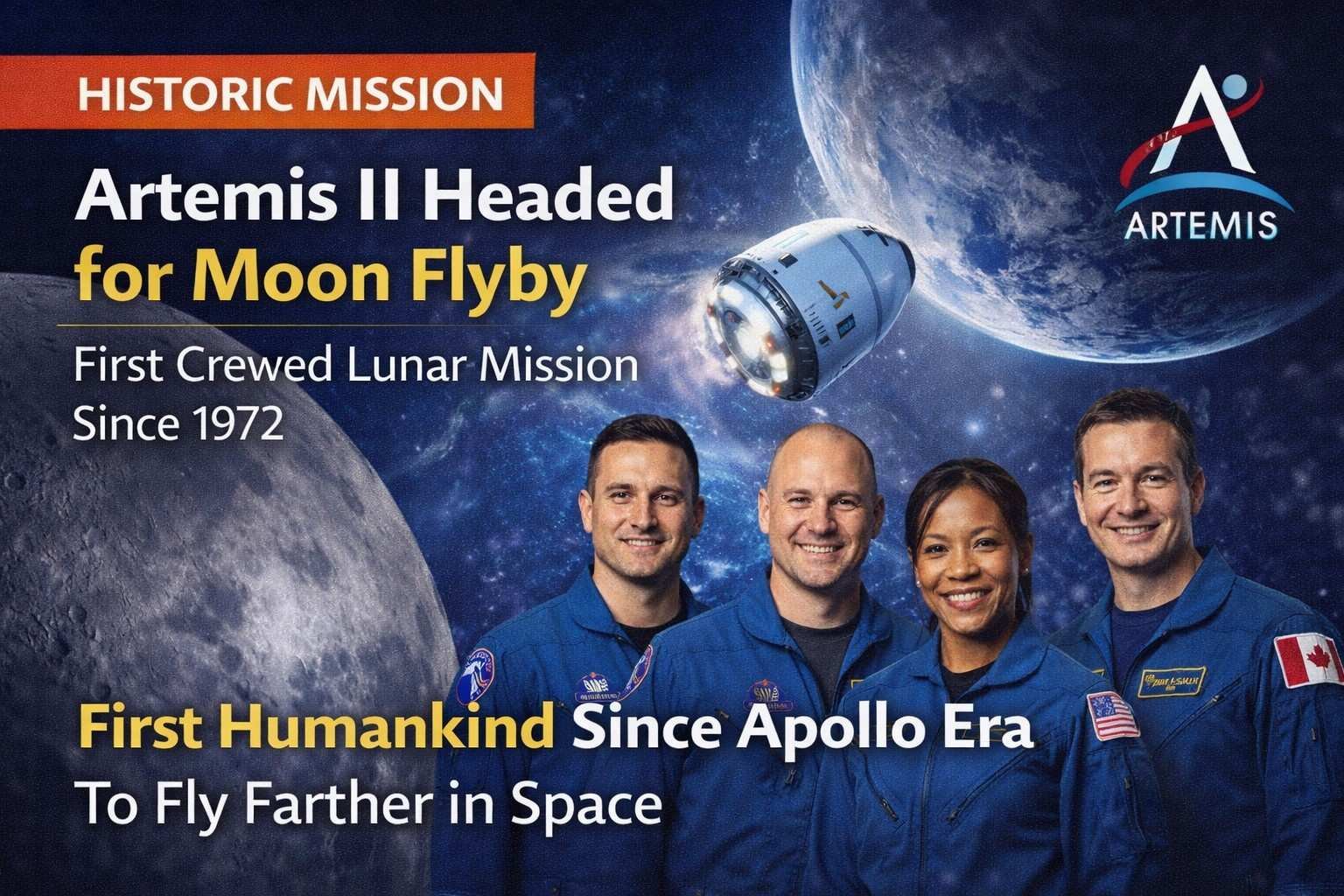
The Artemis II mission has entered a historic phase as astronauts prepare for a close lunar flyby, marking humanity’s first crewed journey to the Moon since the Apollo program ended in 1972.
The four-member crew—three Americans and one Canadian—are set to become the farthest humans from Earth, surpassing the record set by Apollo 13.
A Record-Breaking Journey
Artemis II is following a free-return trajectory, a path that loops around the Moon and naturally brings the spacecraft back to Earth.
- Apollo 13 record: 248,655 miles (400,171 km) from Earth
- Artemis II expected distance: ~3,400 miles farther
This milestone represents a symbolic bridge between past lunar missions and future exploration goals.
Close Encounter with the Moon
During the flyby:
- The spacecraft will pass within 4,000 miles (6,400 km) of the Moon
- Astronauts will capture rare views of the far side, including regions like the Orientale Basin
- The crew will document observations using professional cameras and handheld devices
According to NASA scientists, some visible areas may include terrain never directly seen by humans before.
Rare Space Phenomenon: Solar Eclipse
A major highlight of the mission is a total solar eclipse, visible only from the spacecraft.
- The Moon will block the Sun
- Astronauts will observe the solar corona (outer atmosphere)
- The event will not be visible from Earth
This offers a unique scientific opportunity to study solar activity from deep space.
Communication Blackout
As the Orion spacecraft moves behind the Moon:
- Communication with Earth will be lost for about 40 minutes
- This is due to lack of direct line-of-sight with NASA’s Deep Space Network
- Similar blackouts occurred during Apollo missions
Despite the temporary silence, mission experts emphasize that orbital physics ensures safe return.
Return Journey to Earth
After completing the lunar flyby:
- The spacecraft will begin a 4-day return journey
- Planned splashdown: Pacific Ocean near San Diego
- Total mission duration: ~9 days
In a unique moment, Artemis II astronauts will also communicate with the International Space Station crew, marking the first time lunar and orbital crews interact simultaneously.
Significance of Artemis II
The mission is a crucial step toward:
- Establishing a sustainable human presence on the Moon
- Building future infrastructure like lunar bases, rovers, and habitats
- Enabling long-term goals such as Mars exploration
Conclusion
Artemis II represents a new era of space exploration, combining cutting-edge technology with lessons from past missions. By pushing human boundaries farther into space, it sets the stage for a future where the Moon becomes a gateway for deeper space missions.