

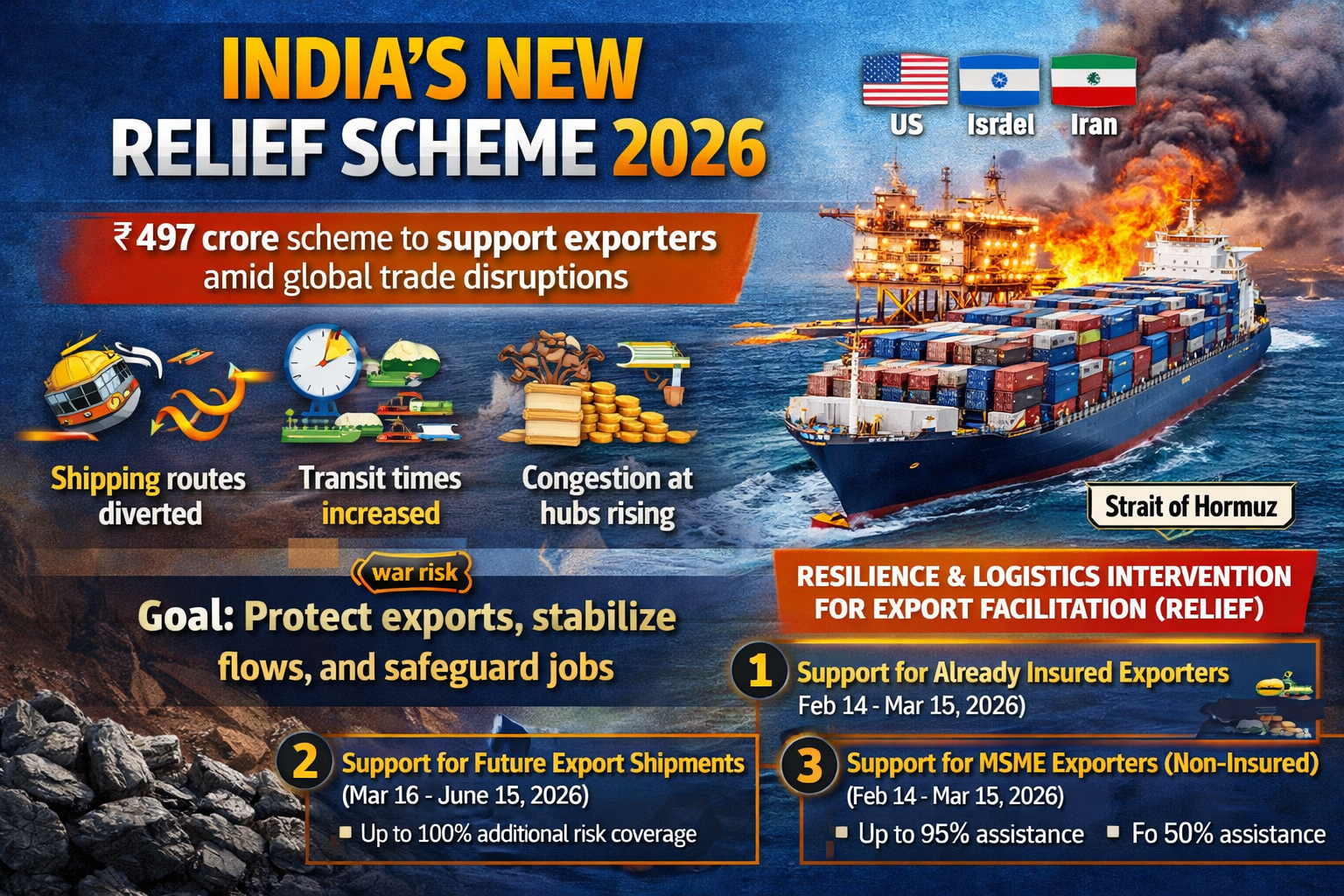
In response to rising global trade disruptions, the Government of India has unveiled a ₹497 crore scheme titled Resilience & Logistics Intervention for Export Facilitation (RELIEF). The initiative aims to support Indian exporters facing challenges due to the ongoing conflict in West Asia.

Launched by the Ministry of Commerce and Industry under the Export Promotion Mission (EPM), the scheme is designed as a time-bound and targeted intervention to address rising logistics costs, insurance premiums, and export risks.
Why the RELIEF Scheme Was Introduced
The escalating conflict involving the United States, Israel, and Iran has significantly impacted global shipping routes, especially around the Strait of Hormuz.
As a result:
Shipping routes have been diverted
Transit times have increased
Congestion at transshipment hubs has risen
Freight charges and war-risk insurance premiums have surged
These disruptions have created uncertainty for exporters, particularly those shipping goods to or through the Middle East.
Impact on Indian Exporters
According to Commerce Secretary Rajesh Agrawal, exporters are facing serious challenges, including:
Delays in shipments reaching destinations
Rising logistics costs
Payment delays
Increased working capital pressure
The situation has hit MSME exporters the hardest, especially those dealing in perishable goods, as cargo accumulation at ports and airports has worsened.
Key Objective of RELIEF Scheme
The scheme aims to:
Stabilize export flows
Reduce financial stress on exporters
Prevent order cancellations
Protect India’s global trade share
Safeguard employment in export-driven sectors
Implementation Mechanism
The scheme will be implemented by ECGC Ltd, which will handle:
Verification of claims
Settlement and disbursement
Risk coverage management
Countries Covered Under the Scheme
The RELIEF scheme covers exports to or via major West Asian nations, including:
UAE
Qatar
Oman
Bahrain
Kuwait
Israel
Iraq
Iran
Yemen
Three Key Components of RELIEF
1. Support for Already Insured Exporters
Applicable for shipments between Feb 14 – Mar 15, 2026
Up to 100% additional risk coverage over existing ECGC cover
Estimated government support: ₹56 crore
2. Support for Future Export Shipments
Applicable from Mar 16 – June 15, 2026
Up to 95% additional risk coverage
Encourages exporters to continue shipments despite uncertainties
Estimated support: ₹159 crore
3. Support for MSME Exporters (Non-Insured)
Covers exporters without ECGC insurance
Provides up to 50% reimbursement of extra freight and insurance costs
Valid for Feb 14 – Mar 15, 2026
Estimated support: ₹282 crore
Maximum benefit capped at ₹50 lakh per exporterIndustry Perspective
Director General of Foreign Trade Santosh Kumar Sarangi (DGFT head) emphasized that such calibrated support is essential to maintain export momentum during global crises. He noted that similar disruptions, like the Red Sea crisis, had earlier caused freight rates to spike by nearly 90–100%.
Conclusion
The RELIEF scheme reflects the government’s proactive approach to protecting India’s export sector during global uncertainties. By addressing logistics disruptions and financial risks, the initiative aims to ensure that Indian exporters remain competitive and resilient, even in challenging geopolitical conditions.