

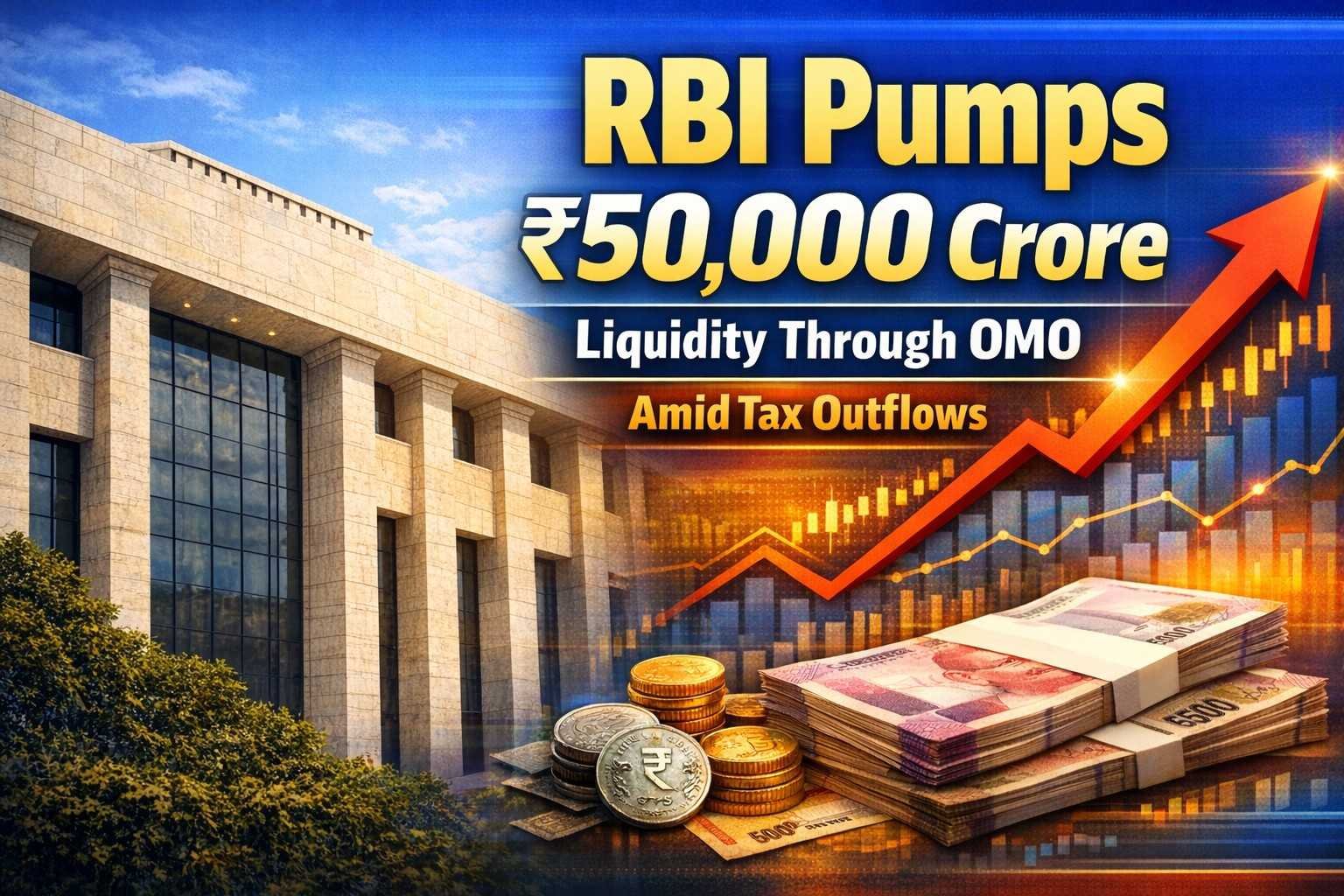
The Reserve Bank of India (RBI) injected ₹50,000 crore into the inter-bank system on Friday through open market operations (OMOs) by purchasing government securities. The move aims to maintain adequate liquidity in the banking system ahead of large advance tax and GST payments due later in the month as the financial year closes.
Key Highlights:
- RBI purchased government securities worth ₹50,000 crore through OMO.
- The operation was conducted to ensure surplus liquidity in the banking system.
- Large advance tax and GST payments typically tighten liquidity toward the end of the fiscal year.
- Banking system liquidity surplus stood at around ₹2.49 lakh crore on Thursday.
- India’s 10-year benchmark government bond yield remained steady at 6.68% on Friday following the liquidity infusion.
Why RBI Injected Liquidity:
- Towards the end of the financial year, large tax payments such as advance tax and GST typically lead to liquidity tightening in the banking system.
- When companies and individuals pay taxes, funds move from banks to the government, temporarily reducing available liquidity.
- To prevent sudden liquidity shortages and maintain stable financial conditions, RBI conducts OMOs by purchasing government securities from banks.
Recent RBI Liquidity Measures:
- The central bank had already injected ₹57,210 crore last week through secondary market government security purchases to help stabilize bond yields amid global uncertainty linked to the West Asia conflict.
- Friday’s operation was part of two planned OMO auctions of ₹50,000 crore each announced earlier by RBI.
Government Securities Purchased:
RBI accepted bids worth ₹1.08 lakh crore and purchased multiple securities including:
- 6.45% GS 2029 – ₹13,006 crore
- 7.95% GS 2032 – ₹2,908 crore
- 6.79% GS 2034 – ₹4,496 crore
- 6.64% Stock 2035 – ₹8,350 crore
- 7.41% Security 2036 – ₹14,491 crore
- 7.62% GS 2039 – ₹1,749 crore
- 7.06% Stock 2046 – ₹5,000 crore
Total Liquidity Infused in 2026:
- So far in calendar year 2026, RBI has infused approximately ₹3.50 lakh crore into the financial system through OMO operations to maintain stable liquidity conditions.
What is Open Market Operation (OMO)?
- Open Market Operations are a monetary policy tool through which the RBI buys or sells government securities in the open market to regulate liquidity and influence interest rates in the economy.
Objectives of OMO:
OMO is used to:
- Control money supply
- Manage short-term interest rates
- Maintain banking system liquidity
- Stabilize government bond yields
- Support economic growth
Types of OMO:
When RBI buys government bonds from banks or financial institutions:
- Money flows into the banking system
- Banks have more funds to lend
- Interest rates may fall
- Economic activity can increase