

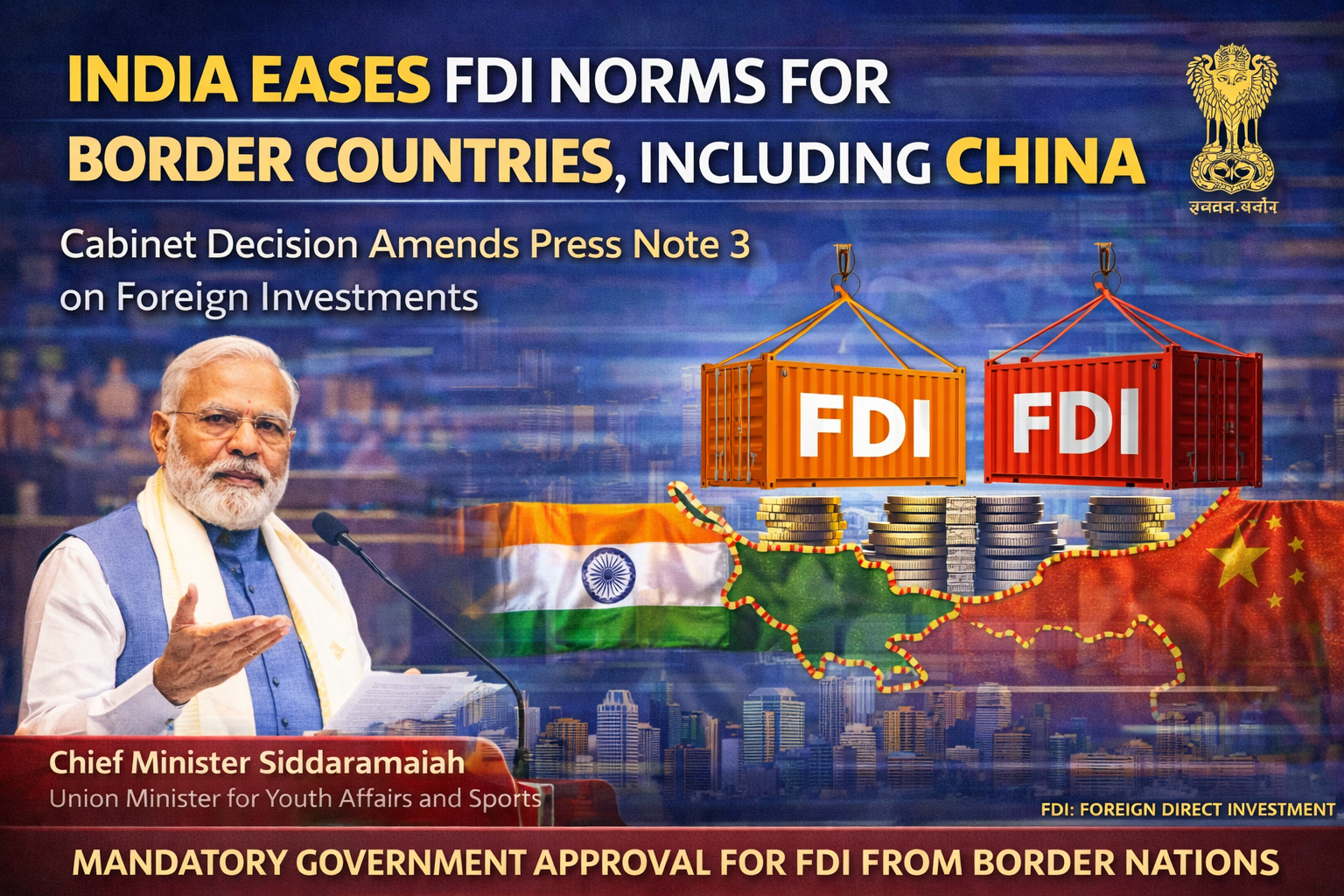
The Government of India has decided to ease foreign direct investment (FDI) norms for countries sharing land borders with India, including China, according to official sources. The decision was taken during a meeting of the Union Cabinet chaired by Prime Minister Narendra Modi.

As part of the move, the government has amended Press Note 3, which previously required mandatory government approval for investments from companies that had shareholders based in neighbouring countries.
Background of Press Note 3
The Press Note 3 was introduced in 2020 during heightened tensions between India and China. Under this rule, investments from entities located in countries sharing land borders with India required prior government approval, regardless of the sector.
The countries covered under this policy include:
China
Bangladesh
Pakistan
Bhutan
Nepal
Myanmar
Afghanistan
The amendment is expected to simplify the investment process and improve the investment climate.
China’s Share in India’s FDI
Despite the restrictions introduced in 2020, China accounts for a relatively small share of foreign investment in India. Between April 2000 and December 2025, China contributed about USD 2.51 billion, representing only 0.32% of the total FDI equity inflows into India.
Background: India–China Tensions
Relations between India and China deteriorated significantly after the Galwan Valley clash in June 2020, which marked the most serious military confrontation between the two countries in decades.
Following the incident, India took several steps, including banning more than 200 Chinese mobile applications, such as:
TikTok
WeChat
UC Browser
These measures were introduced citing concerns related to national security and data protection.
India–China Trade Relations
Although foreign investment from China remains limited, bilateral trade between the two countries has grown significantly over the years. China has become India’s second-largest trading partner.
Trade in 2024–25
India’s exports to China declined by 14.5% to USD 14.25 billion, compared to USD 16.66 billion in 2023–24.
Imports from China increased 11.52% to USD 113.45 billion, up from USD 101.73 billion the previous year.
This pushed India’s trade deficit with China to USD 99.2 billion in 2024–25, compared to USD 85 billion in 2023–24.
Trade in 2025–26 (April–January)
During the first ten months of 2025–26, trade trends showed further growth:
Exports from India to China increased 38.37% to USD 15.88 billion.
Imports from China rose 13.82% to USD 108.18 billion.
The trade deficit during this period stood at USD 92.3 billion.
The easing of FDI norms for neighbouring countries, including China, marks an important policy shift by the Indian government. While security concerns remain a key factor in policymaking, the move is expected to encourage investment flows and improve the overall investment environment in India.
At the same time, the evolving trade relationship between India and China continues to play a major role in shaping economic ties between the two nations.