

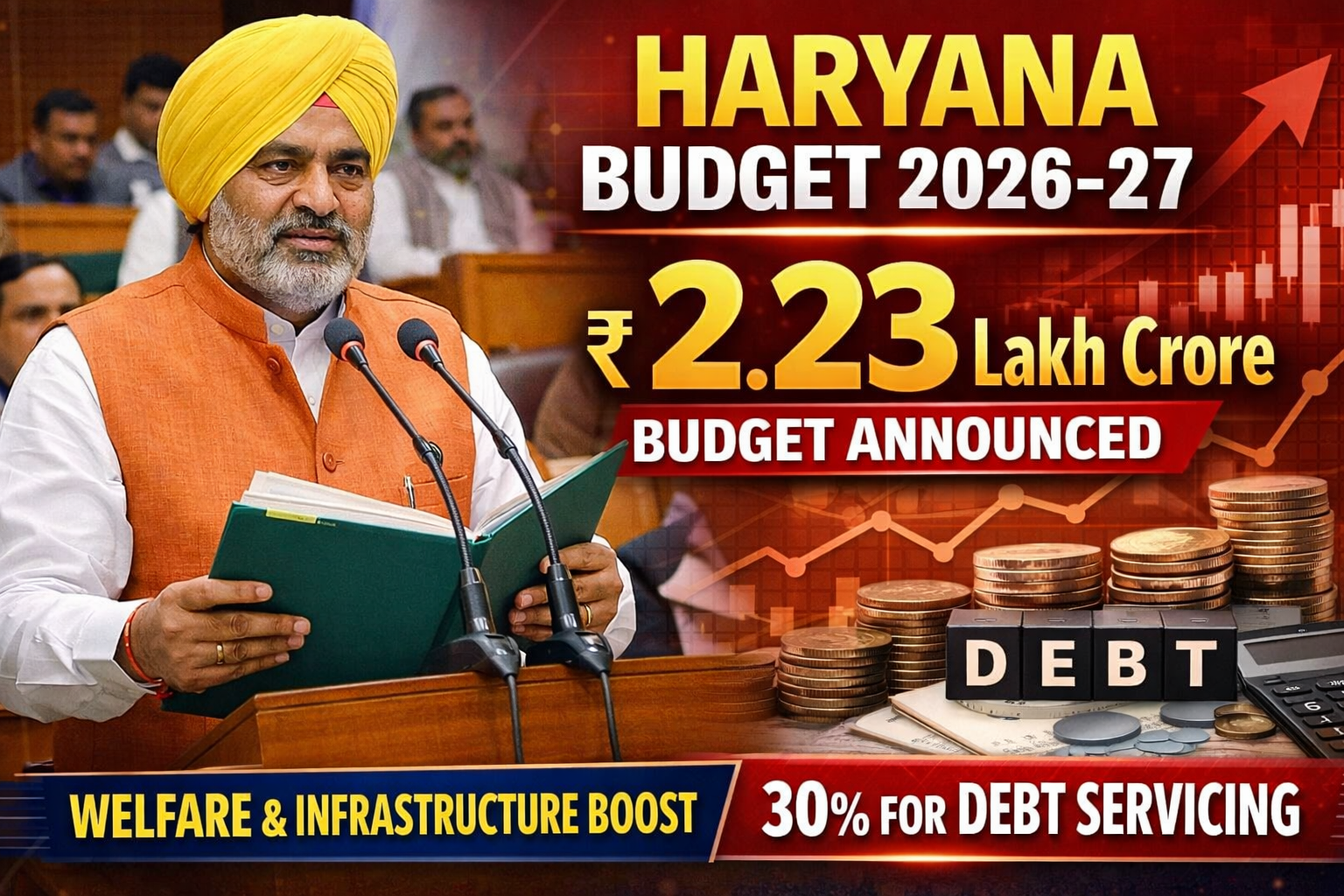
Haryana Chief Minister Nayab Singh Saini presented a ₹2.23 lakh crore budget for the financial year 2026–27 in the state assembly, outlining a mix of welfare initiatives, infrastructure development, and fiscal discipline. A significant portion of the budget — nearly 30% — will go toward debt servicing, reflecting the state’s ongoing financial commitments.
Fiscal Position and Debt Burden
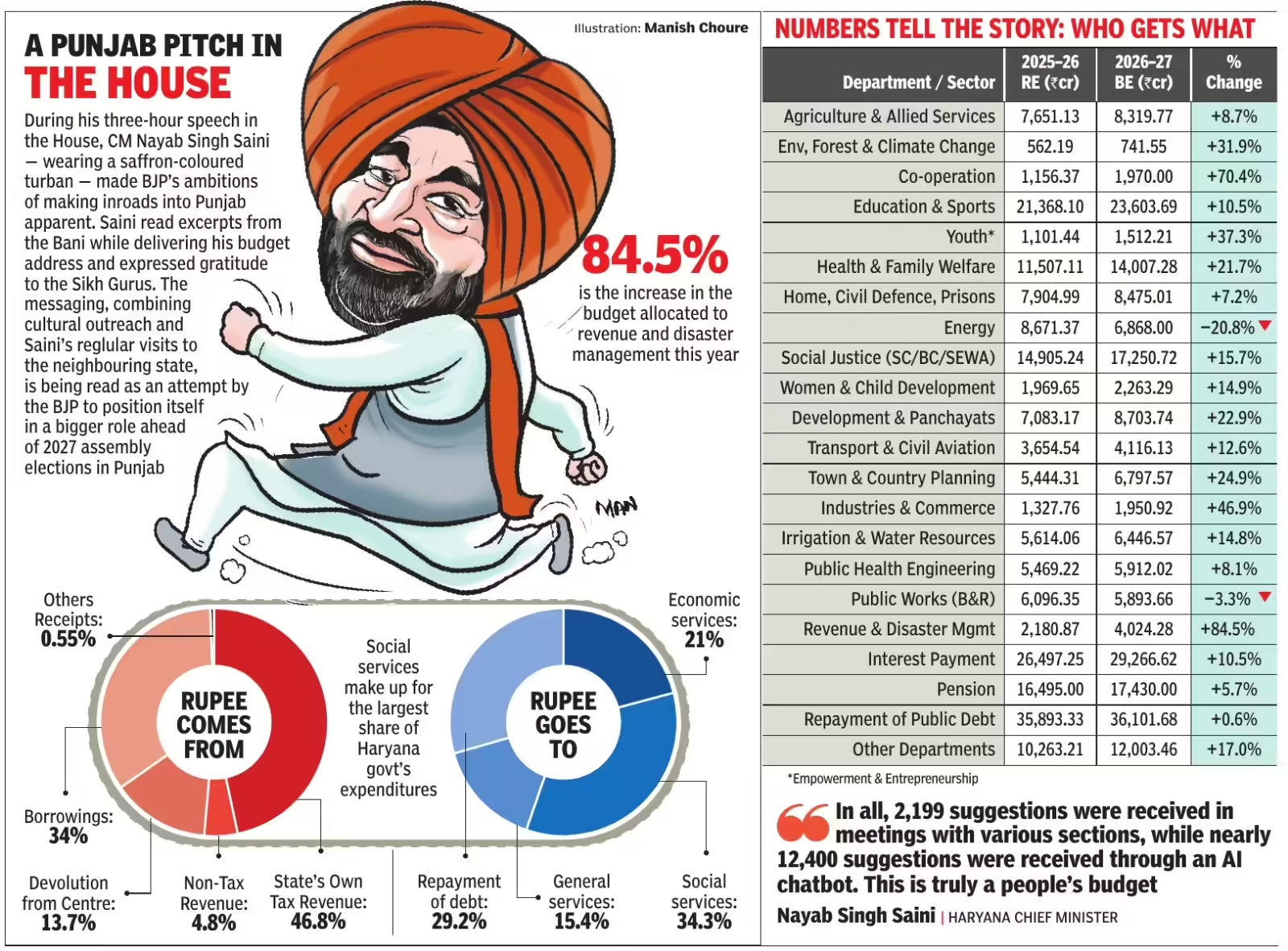
The state’s total debt servicing liability stands at ₹65,368 crore, including ₹29,266.62 crore in interest payments and ₹36,101.68 crore for repayment of public debt. The revenue deficit has been pegged at ₹4,293.17 crore (2.65% of GDP). For 2025–26, the fiscal deficit is estimated at 2.66% of GDP, while for 2026–27, it is expected to be contained at 2.65%.
Haryana’s share in central taxes will be 1.361% from 2026 to 2031, as per the recommendations of the 16th Finance Commission.
Key Announcements and New Initiatives
The Chief Minister announced several major initiatives across sectors:
- A new power distribution company dedicated to the agriculture sector.
- A ₹100-crore Green Climate Resilience Fund.
- 20% reservation for Agniveers in the state police force.
- Establishment of ‘Adarsh Pariksha Kendras’ under the public-private partnership model.
- Creation of an Anti-Terrorist Squad (ATS) under an IG-rank officer.
- Development of ‘Wedding Cities’ in Gurugram, Kharkhoda, and Pinjore under the “Wed in India” concept.
- A modern Film City at Pinjore.
- Upgradation of Rajiv Gandhi Sports Complex, Daulatabad into Haryana’s first Para Sports Stadium.
Sector-Wise Allocations
Education and sports received ₹23,603.69 crore, while health was allocated ₹14,007.28 crore. Social justice received ₹17,250.72 crore, followed by development and panchayats (₹8,703.74 crore) and home department (₹8,475.01 crore).
Infrastructure sectors such as irrigation, public works, and urban local bodies continue to receive steady funding, although the energy sector saw a reduction in allocation.
The budget also indicates sharp increases in:
- Revenue and disaster management (+84.5%)
- Co-operation (+70.4%)
- MSME/industries (+46.9%)
- Youth empowerment (+37.3%)
Health, rural development, and urban planning also recorded strong increases, highlighting the government’s focus on grassroots development.
Clean Air and Water Projects
The Chief Minister announced that the World Bank has approved financial assistance of ₹2,716 crore for the Haryana Clean Air Project, which aims to tackle air pollution across all districts by 2031. Additional approvals are expected by October 2026 for:
- ₹5,715 crore under the Water Secure Haryana project.
- ₹474 crore for the Haryana AI Mission.
Institutional and Governance Reforms
Saini identified three key state institutions — gram sabhas, primary agricultural credit societies (PACS), and labour and construction cooperative societies — as pillars of grassroots governance.
From 2026–27:
- Six new agenda items will be mandatory in gram sabha meetings.
- At least 300 loss-making PACS will be targeted for revival.
- Government works worth ₹4,000 crore will be allocated to labour and construction cooperative societies.
- A new ₹500 crore ‘Saksham’ special fund will be established.
- The block-based industrial incentive system will be replaced with a new framework applicable across all blocks.
- Minimum wages will be increased.
Agriculture and Rural Development
In agriculture, the government plans to bring 1.4 lakh additional acres under cultivation in districts such as Bhiwani, Rohtak, and Gurugram.
Key incentives include:
- ₹2,000 per acre bonus for farmers shifting from paddy to oilseeds and cotton.
- Increase in sugarcane incentive from ₹3,000 to ₹5,000 per acre.
- Compensation under Mukhyamantri Bagwani Bima Yojana to rise from ₹40,000 to ₹50,000 per acre.
- Establishment of Rural Haat Mandis across the state.
- A Haryana Veterinary Epidemiology Centre in Hisar at a cost of ₹30 crore.
- Opening of 2,000 new Vita booths and milk bars.
Overall Outlook
The 2026–27 budget reflects continuity in welfare-driven spending while acknowledging the significant burden of debt servicing. With a focus on agriculture, youth employment, disaster preparedness, cooperative institutions, and environmental sustainability, the government has attempted to balance fiscal discipline with development priorities.