

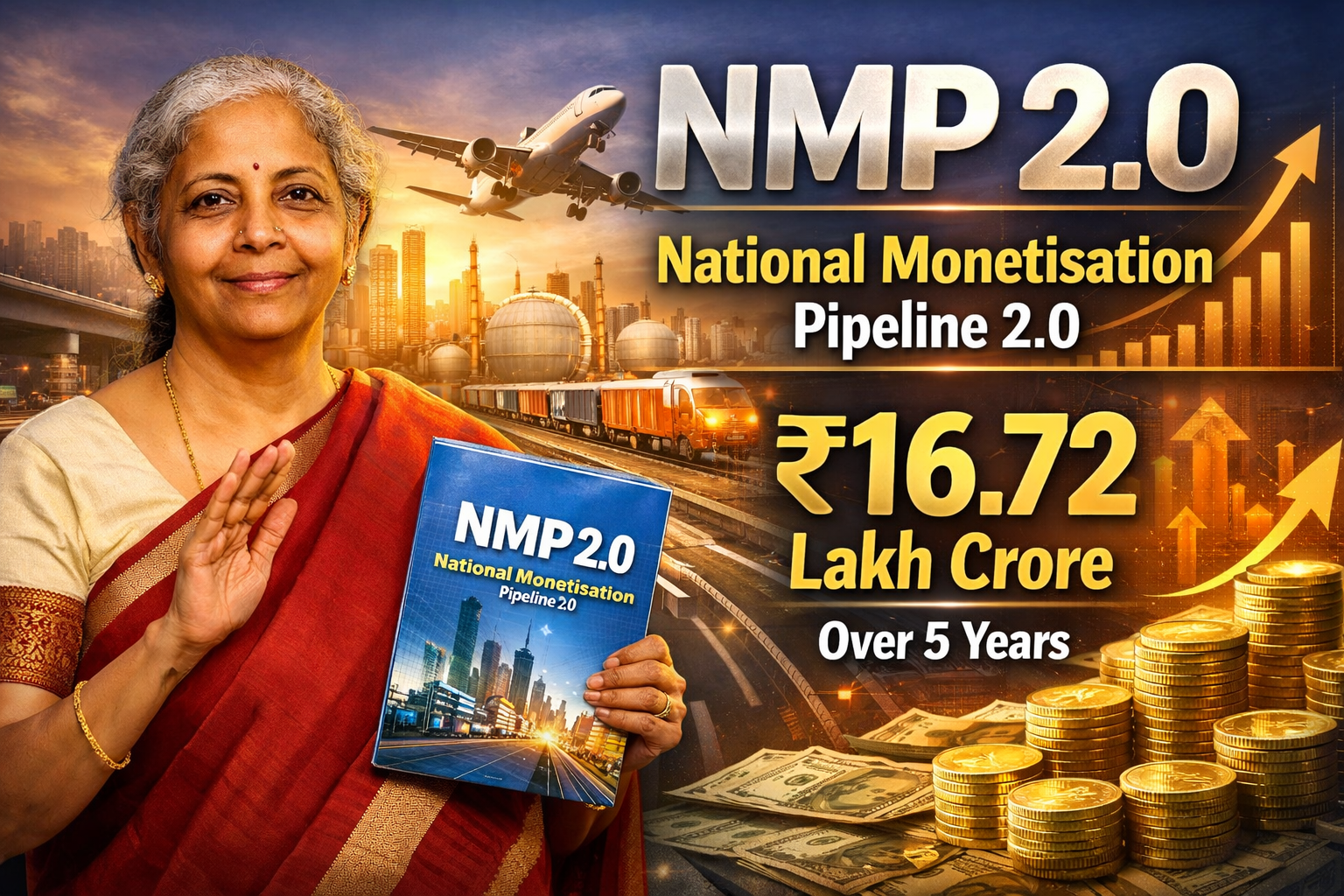
Finance Minister Nirmala Sitharaman has launched the National Monetisation Pipeline 2.0 (NMP 2.0), with the government estimating asset monetisation proceeds of ₹16.72 lakh crore over a five-year period starting April 2025.

Prepared by NITI Aayog, the second phase of the pipeline is aligned with the ‘Asset Monetisation Plan 2025–30’ announced in the Union Budget 2025–26. The projected monetisation potential of ₹16.72 lakh crore is significantly higher than the earlier estimate of ₹10 lakh crore mentioned in the Budget.
The first phase of the National Monetisation Pipeline was launched in 2021 to unlock value from underutilised public infrastructure assets. It involved measures such as transferring assets for a limited period, divesting portions of listed entities, securitising cash flows, and conducting strategic commercial auctions. According to NITI Aayog, the first phase led to greater participation of institutional investors, including pension and sovereign wealth funds, in India’s infrastructure development.
NMP 2.0 will be implemented during FY 2025–26 to FY 2029–30. The total monetisation potential of ₹16.72 lakh crore includes private investments worth ₹5.8 lakh crore.
A major share—₹4.42 lakh crore—is expected to come from the monetisation of 21,300 kilometres of highways, 15 Multi-Modal Logistics Parks, and six ropeways.
Sector-wise estimated monetisation values include:
- Power – ₹2.77 lakh crore
- Ports – ₹2.64 lakh crore
- Railways – ₹2.62 lakh crore
- Coal – ₹2.16 lakh crore
- Mines – ₹1 lakh crore
- Urban infrastructure – ₹52,000 crore
- Civil aviation – ₹27,500 crore
- Petroleum and natural gas – ₹16,300 crore
- Warehousing and storage – ₹10,000 crore
- Telecom – ₹4,800 crore
- Tourism – ₹1,200 crore
The plan also includes listing a minority stake in GAIL Gas, divesting Airports Authority of India’s holdings in one subsidiary and four joint-venture airports, developing select land parcels of major port authorities and the Food Corporation of India through the Public-Private Partnership (PPP) model, auctioning around 94 coal mines, and leasing 38 land parcels of Bharat Sanchar Nigam Limited (BSNL) on a long-term basis.
The government estimates that the largest portion of the proceeds from NMP 2.0 will flow to the Consolidated Fund of India. The remaining proceeds are expected through direct private investment, allocations to public sector undertakings or port authorities, and contributions to State Consolidated Funds.
Overall, NMP 2.0 aims to enhance private sector participation in infrastructure, improve asset utilisation, and generate fiscal space for fresh capital expenditure, thereby supporting India’s long-term economic growth.