

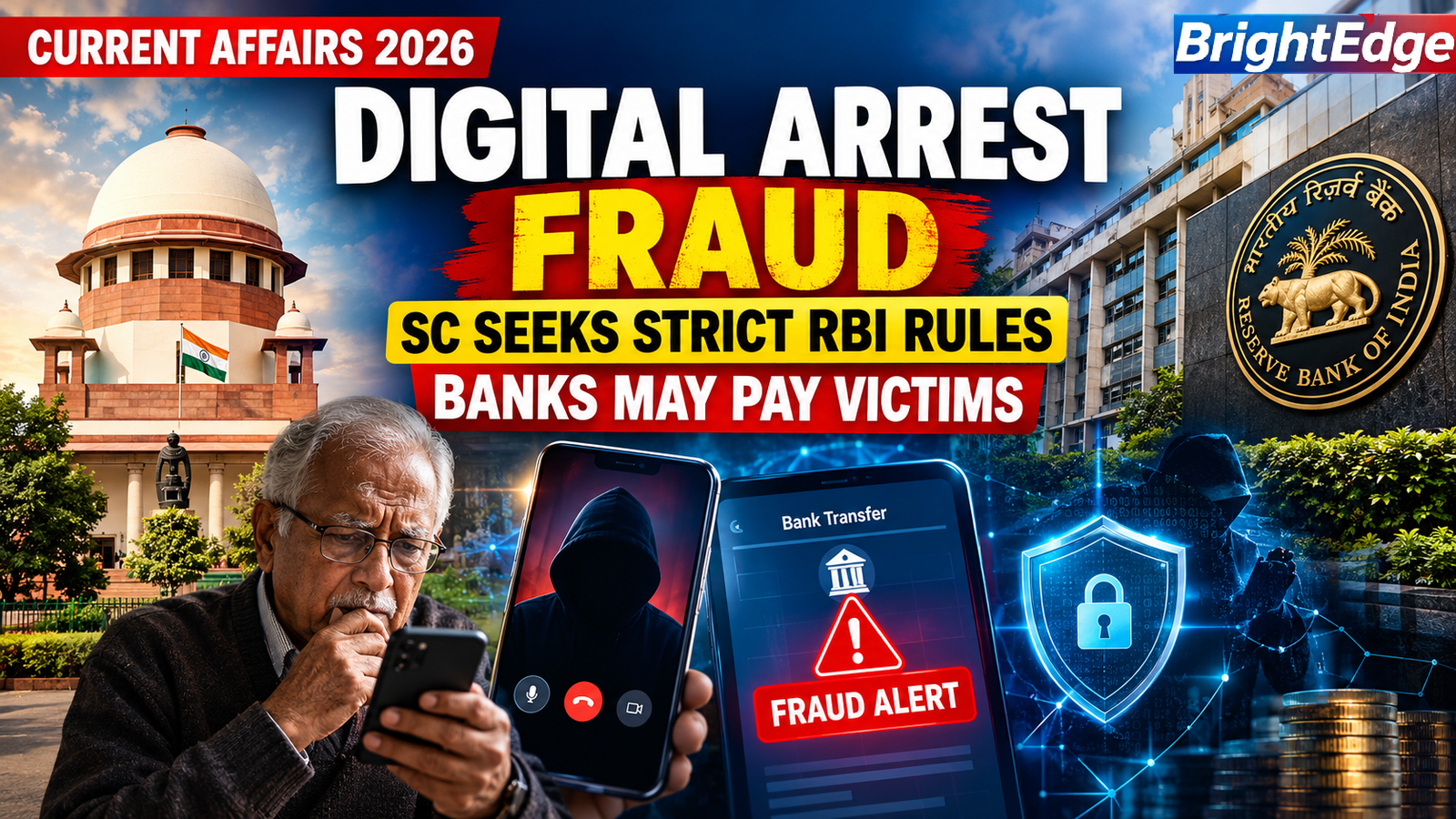
The Supreme Court of India has called for strict regulatory measures against digital arrest scams, directing the Reserve Bank of India (RBI) to ensure that banks and financial institutions compensate victims when cyber fraud occurs due to their failure to exercise proper due diligence.
In a significant development on October 29, 2026, the Supreme Court emphasised that banks must take greater responsibility for preventing suspicious financial transactions and protecting customers from cybercriminals.
The Court also called for mandatory safeguards, including temporary suspension of unusual transactions, automated reporting and physical verification before suspicious transactions are processed.
The development is part of the Supreme Court’s ongoing suo motu proceedings concerning digital arrest scams and financial cyber fraud in India.
1. What Has the Supreme Court Directed?
A three-judge Bench comprising Chief Justice of India Surya Kant, Justice Joymalya Bagchi and Justice V Mohana examined the proposed regulatory framework of the Reserve Bank of India to tackle digital arrest and cyber fraud.
The Court emphasised that financial institutions must be held accountable when their failure to exercise due diligence contributes to financial fraud.
The key directions and observations include:
- Victim Compensation: RBI’s proposed regulatory measures must provide for compensation of not less than the amount lost by victims where fraud results from a financial institution’s failure to exercise due diligence.
- Suspension of Suspicious Transactions: Banks must temporarily suspend unusual transactions that are inconsistent with a customer’s historical banking behaviour.
- Automated Reporting: Financial institutions should establish systems to automatically report suspicious transactions to the relevant authorities.
- Physical Verification: Banks should undertake physical verification to establish the genuineness of suspicious transactions.
- Bank Accountability: Financial institutions must introduce stronger safeguards to prevent the misuse of banking services by cybercriminals.
- Regulatory Oversight: RBI must submit the draft regulatory framework and a list of authorised financial institutions before the next hearing.
The Court stressed that banks must act as a protective umbrella for customers, particularly senior citizens and vulnerable account holders.
2. Why Did the Supreme Court Intervene?
- The Supreme Court’s intervention follows increasing concerns about organised digital arrest scams targeting ordinary citizens, particularly senior citizens.
- The proceedings originated from a complaint by an elderly couple who reportedly lost approximately ₹1.05 crore after fraudsters impersonated government officials and judicial authorities.
- The criminals allegedly used forged Supreme Court orders and threats of arrest to intimidate the victims into transferring their money.
- The fraudsters exploited people’s fear of law enforcement agencies by conducting fake investigations through telephone and video calls.
- The incident prompted the Supreme Court to initiate suo motu proceedings to examine the broader institutional failures contributing to digital arrest fraud.
- The Court questioned why banks could not identify and intervene when customers suddenly transferred unusually large amounts of money inconsistent with their regular banking patterns.
3. What Is Digital Arrest Fraud?
Digital arrest is a form of cybercrime in which fraudsters impersonate police officers, CBI officials, Enforcement Directorate officers, judges or other government authorities.
They contact victims through phone calls, WhatsApp messages and video conferencing platforms.
The criminals falsely accuse victims of involvement in serious offences such as money laundering, drug trafficking, financial fraud or other criminal activities.
Victims are threatened with:
- Immediate arrest.
- Property seizure.
- Freezing of bank accounts.
- Legal proceedings.
- Criminal prosecution.
- Family members being implicated in criminal cases.
Fraudsters frequently use fake identity cards, forged government documents, fabricated arrest warrants and counterfeit judicial orders to make their threats appear genuine.
They then force victims to transfer money under the pretext of police verification, security deposits or account investigations.
Important: There is no legal procedure called digital arrest in India. Genuine police officers and investigating agencies do not conduct arrests through WhatsApp or video calls or demand money for verification.
4. What New Responsibilities May Banks Face?
The Supreme Court has highlighted the importance of making banks more accountable for preventing cyber-enabled financial fraud.
Under the proposed RBI regulatory framework, financial institutions may be required to strengthen their transaction-monitoring systems.
| Proposed Safeguard | Expected Function |
|---|---|
| Suspicious Transaction Monitoring | Identify unusual transactions based on customer history |
| Temporary Transaction Suspension | Hold suspicious transactions until verification |
| Automated Reporting | Alert relevant authorities about suspicious activity |
| Physical Verification | Verify the authenticity of unusual transactions |
| Victim Compensation | Compensate customers where bank negligence contributed to fraud |
| Stronger Banking Controls | Prevent misuse of accounts for cybercrime |
The Court also questioned whether existing banking safeguards had sufficient enforcement mechanisms to prevent such frauds.
The proposed framework is intended to shift greater responsibility towards financial institutions rather than placing the entire burden of protection on customers.
5. What Is RBI’s Proposed Timeline?
During the hearing, Attorney General R. Venkataramani informed the Court that the RBI was working on regulatory measures to address digital arrest and cyber fraud.
He indicated that technical integration and consultations with banks were underway.
The proposed timeline discussed before the Court was:
| Development | Proposed Timeline |
|---|---|
| Notification of RBI regulations | By November 30, 2026 |
| Operationalisation of regulatory framework | By December 31, 2026 |
| Next Supreme Court hearing | November 30, 2026 |
These were timelines indicated during the proceedings and should not be confused with already implemented regulations.
The Supreme Court also directed RBI to submit a list of authorised financial institutions covered by the proposed framework.
6. Other Measures Discussed to Prevent Digital Arrest Scams
Apart from banking regulations, the Supreme Court discussed several additional technological and institutional safeguards.
These include:
- Exploring an optional WhatsApp kill-switch feature to help users respond to suspicious communications.
- Introducing warnings during unusually prolonged calls.
- Providing simultaneous alerts to users about suspected cybercrime.
- Strengthening accountability for misuse of SIM cards and telecom infrastructure.
- Improving coordination between intermediaries, law enforcement agencies and the government’s inter-departmental committee.
- Requiring State and Union Territory police chiefs to submit reports on FIRs, investigations and preventive measures.
The Court also discussed the need for stronger technological integration between financial institutions and cybercrime authorities.
7. How Can Citizens Protect Themselves from Digital Arrest Scams?
Citizens should follow these precautions to avoid becoming victims of digital arrest fraud:
- Never transfer money because someone claims to be a police officer or government official.
- Do not trust arrest warrants or court orders shared through WhatsApp.
- Never share OTPs, PINs, passwords or banking credentials.
- Avoid installing applications or sharing your screen at the request of unknown callers.
- Verify suspicious claims directly with the relevant government agency.
- Immediately inform your bank if you notice suspicious transactions.
- Report cyber financial fraud by calling the national cybercrime helpline 1930.
- Register complaints through the National Cyber Crime Reporting Portal.
Official Reporting Portal: https://cybercrime.gov.in
Cyber Fraud Helpline: 1930
Also,
Click here to read: Supreme Court Tightens Rules Against Rising Digital Arrest Fraud
Click here to read: Cabinet Approves Increase in Supreme Court Judge Strength to 37