

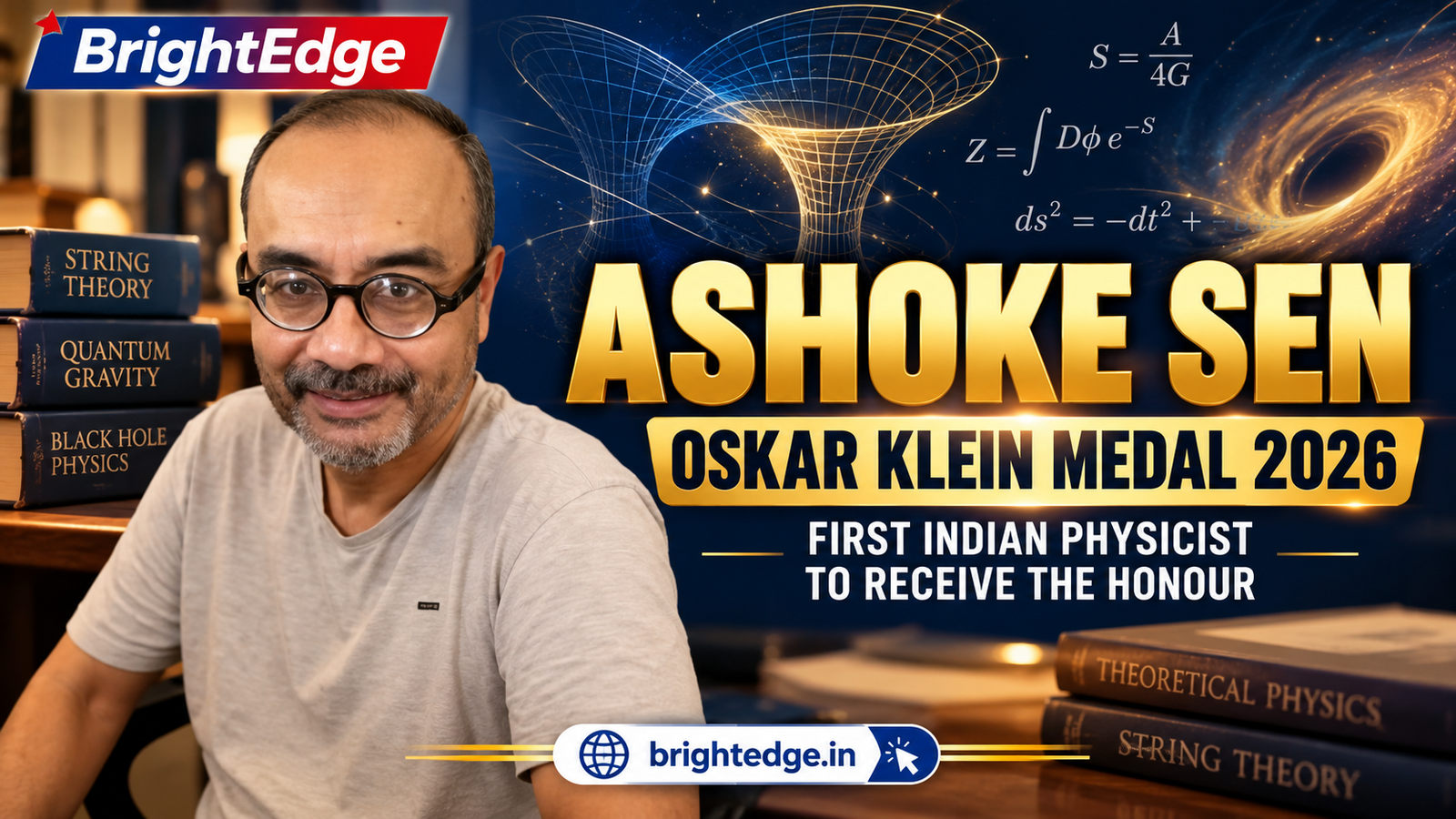
- Indian theoretical physicist Professor Ashoke Sen has been awarded the prestigious Oskar Klein Medal for 2026, becoming the first Indian physicist to receive the honour.
- The recognition celebrates his pioneering contributions to string theory, black-hole entropy and string field theory, which have helped shape modern theoretical physics.
- Sen is an ICTS-Infosys Madhava Chair Professor and is internationally recognised for his influential research into some of the most fundamental questions about the universe.
What Is the Oskar Klein Medal?
- The Oskar Klein Medal is an international physics honour named after Swedish theoretical physicist Oskar Klein.
- Established in 1988, it recognises distinguished contributions to physics.
- The medal is awarded jointly by Stockholm University and the Nobel Committee for Physics of the Royal Swedish Academy of Sciences.
- Previous recipients include prominent physicists and Nobel laureates such as Chen-Ning Yang, Steven Weinberg and Hans Bethe.
- Professor Sen’s selection places his contributions among the internationally recognised achievements in theoretical physics.
All about Ashoke Sen:

- Ashoke Sen was born into a Bengali family. His father was Dhirendra Nath Sen, and his mother was Gouri Sen, a homemaker.
- Sen completed his schooling at Sailendra Sircar Vidyalaya in Kolkata, West Bengal. In 1975, he earned a Bachelor of Science degree from Presidency College, Kolkata, then affiliated with the University of Calcutta.
- The following year, he completed his master’s degree at the Indian Institute of Technology Kanpur.
- During his undergraduate studies at Presidency College, Sen was deeply influenced by the teaching and research of physicist Amal Kumar Raychaudhuri.
- This academic influence helped shape his interest in theoretical physics.
- Sen subsequently pursued doctoral studies in physics at Stony Brook University in New York, United States, where he continued developing his expertise in theoretical physics.
Why Did Ashoke Sen Receive the Oskar Klein Medal 2026?
According to ICTS, Professor Sen was recognised for his pioneering work in three important areas:
- S-duality: Research into mathematical relationships connecting different descriptions of physical theories.
- Black-hole entropy: Work on precisely counting microscopic states associated with certain black holes, helping researchers investigate their quantum properties.
- String field theory: Contributions to the mathematical framework used to study the dynamics and interactions of strings.
These contributions have played an important role in the development of modern string theory and research into the relationship between gravity and quantum physics.
What Is String Theory?
- String theory is a theoretical framework that proposes that the fundamental constituents of nature may be tiny, one-dimensional objects called strings rather than point-like particles.
- Different vibrational states of these strings are associated with different particles. Researchers study the framework as a possible way to understand fundamental interactions and reconcile quantum mechanics with gravity.
- Although string theory remains an active area of theoretical research, many of its predictions are difficult to test experimentally. Work by scientists such as Ashoke Sen has helped deepen understanding of its mathematical structure.
Ashoke Sen Delivers the Oskar Klein Memorial Lecture
- As part of the 2026 recognition, Professor Sen delivered the Oskar Klein Memorial Lecture at Stockholm University’s AlbaNova Centre on October 22.
- The lecture was titled “Gravity from Strings and Strings from Gravity.”
- It explored connections between string theory, gravity and questions involving the quantum properties of black holes.
- The lecture formed part of the programme associated with the prestigious medal.
Ashoke Sen’s Major Awards and Achievements
The Oskar Klein Medal adds to Professor Sen’s distinguished list of scientific honours.
His previous awards include:
- Breakthrough Prize in Fundamental Physics (2012): Recognised his contributions to establishing the unifying structure of string theory.
- Dirac Medal (2014): Awarded for outstanding contributions to theoretical physics.
- Infosys Prize in Mathematical Sciences (2009): Recognised his work in mathematical sciences.
- Padma Shri (2001): One of India’s civilian honours.
- Padma Bhushan (2013): Awarded for distinguished service.
He was also elected a Fellow of the Royal Society in 1998.
Why Is Ashoke Sen’s Achievement Important for India?
- Professor Sen’s achievement highlights the international impact of Indian scientific research.
- His work demonstrates how theoretical research can contribute to the development of ideas that influence scientists’ understanding of fundamental physical laws.
- The award also draws attention to the importance of supporting scientific research, advanced mathematics and theoretical physics in India.
- For students preparing for competitive examinations, this development is relevant to science and technology current affairs, important international awards and the achievements of Indian scientists.
Frequently Asked Questions (FAQs)
Q1. Who won the Oskar Klein Medal 2026?
Professor Ashoke Sen, an Indian theoretical physicist, was awarded the Oskar Klein Medal for 2026.
Q2. Is Ashoke Sen the first Indian to win the Oskar Klein Medal?
Yes. According to the International Centre for Theoretical Sciences, he is the first Indian physicist to receive the honour.
Q3. Who awards the Oskar Klein Medal?
The medal is awarded jointly by Stockholm University and the Nobel Committee for Physics of the Royal Swedish Academy of Sciences.
Q4. Why did Ashoke Sen receive the Oskar Klein Medal?
He was recognised for pioneering contributions to S-duality, the precision counting of black-hole entropy and string field theory.
Q5. What is Ashoke Sen famous for?
He is internationally known for his research in string theory and theoretical physics, particularly his work on dualities, black holes and string field theory.
Q6. When was the Oskar Klein Medal 2026 announced?
The International Centre for Theoretical Sciences announced the award on October 22, 2026.
For more science news, important awards and exam-focused current affairs, follow BrightEdge News.