

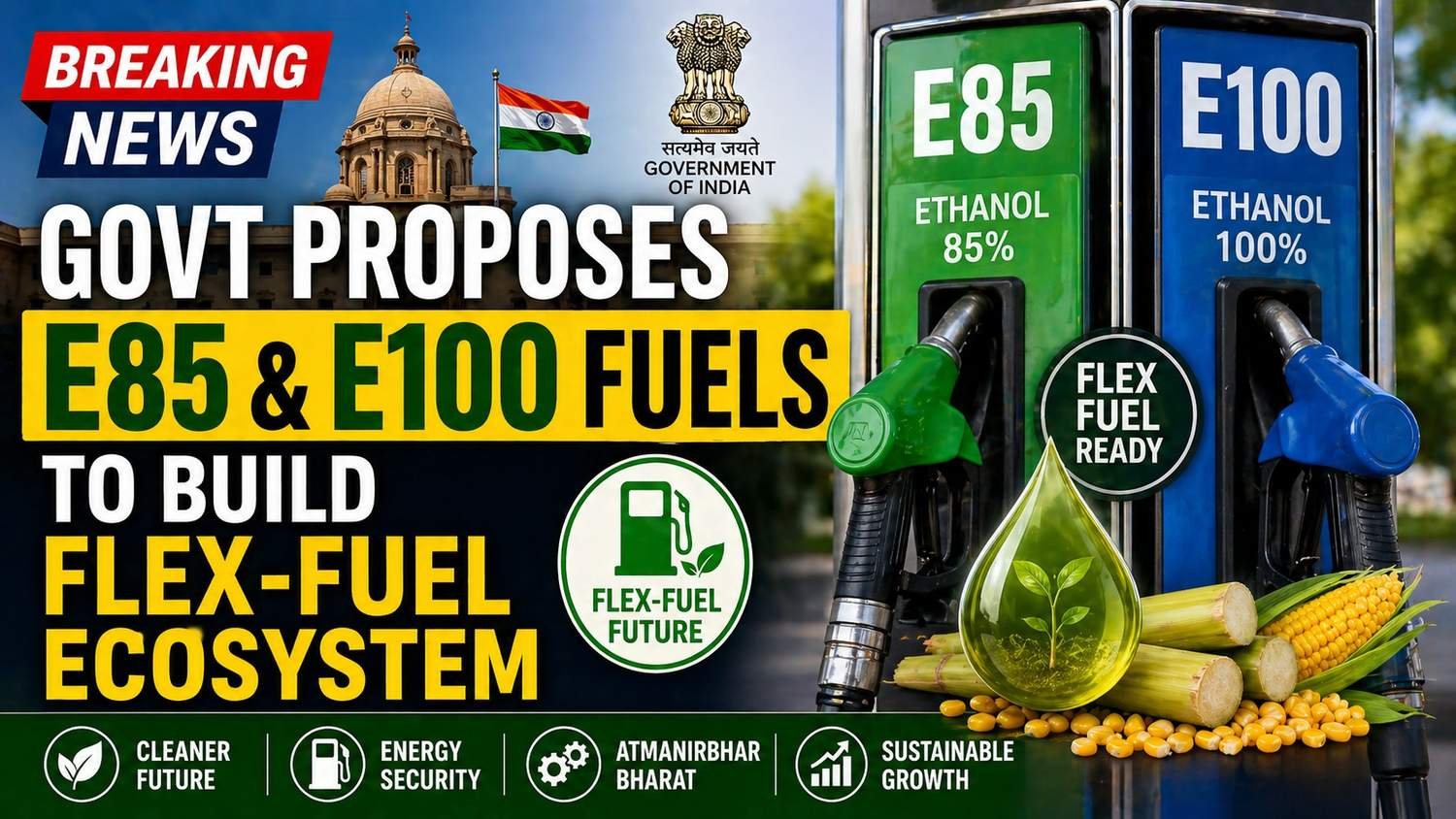
In a major step toward reducing crude oil dependence and boosting clean energy adoption, the Government of India has proposed a regulatory roadmap to introduce higher ethanol-blended fuels like E85 and E100. The move, led by the Ministry of Road Transport and Highways through amendments to the Central Motor Vehicles Rules (CMVR), signals a gradual shift toward a flex-fuel ecosystem in India.
What’s New in the Draft Proposal?
The government has issued a draft notification for public consultation to:
- Recognise E85 (85% ethanol) and E100 (near-pure ethanol) as automotive fuels
- Expand the current fuel framework beyond E20 (20% ethanol blend)
- Standardise fuel definitions and labelling
- Include provisions for alternative fuels
This is not an immediate mandate but a policy enabler, allowing the ecosystem to gradually transition.
Current Status: India at E20 Stage
India has already rolled out E20 fuel in phases, which is now:
- The standard fuel for new petrol vehicles
- Widely available across fuel stations
The proposed shift to E85 and E100 represents the next phase of India’s ethanol blending programme.
What Are E85 and E100 Fuels?
E85 Fuel:
E85=85% ethanol+15% petrolE85 = 85\%\ \text{ethanol} + 15\%\ \text{petrol}
E100 Fuel:
E100≈100% ethanolE100 \approx 100\%\ \text{ethanol}
These fuels are significantly different from E20 and require specialized engine compatibility.
What This Means for Consumers
Short-Term Impact:
- Minimal change
- E20 remains the dominant fuel
Long-Term Impact:
- Availability of multiple fuel options
- Need to check vehicle compatibility before using higher blends
Vehicles designed for E20 may not work efficiently with E85 or E100
Rise of Flex-Fuel Vehicles (FFVs)
The proposal strongly supports the development of flex-fuel vehicles (FFVs).
What Are FFVs?
Vehicles capable of running on:
- Petrol
- E20
- E85
- E100
Key Features:
- Adjust engine performance automatically
- Offer fuel flexibility based on availability
However, FFVs may involve:
- Higher upfront cost
- Engine modifications due to ethanol’s corrosive nature
Comparison: E20 vs E85 vs E100
| Fuel Type | Ethanol Content | Compatibility | Current Availability |
|---|---|---|---|
| E20 | 20% | Standard vehicles | Widely available |
| E85 | 85% | Flex-fuel vehicles | Proposed |
| E100 | ~100% | Special FFVs only | Proposed |
Conclusion:
The government’s proposal to introduce E85 and E100 fuels marks a strategic shift toward a cleaner, self-reliant fuel ecosystem. While the immediate impact on consumers is limited, the long-term vision is clear—India is moving toward a multi-fuel future powered by biofuels.